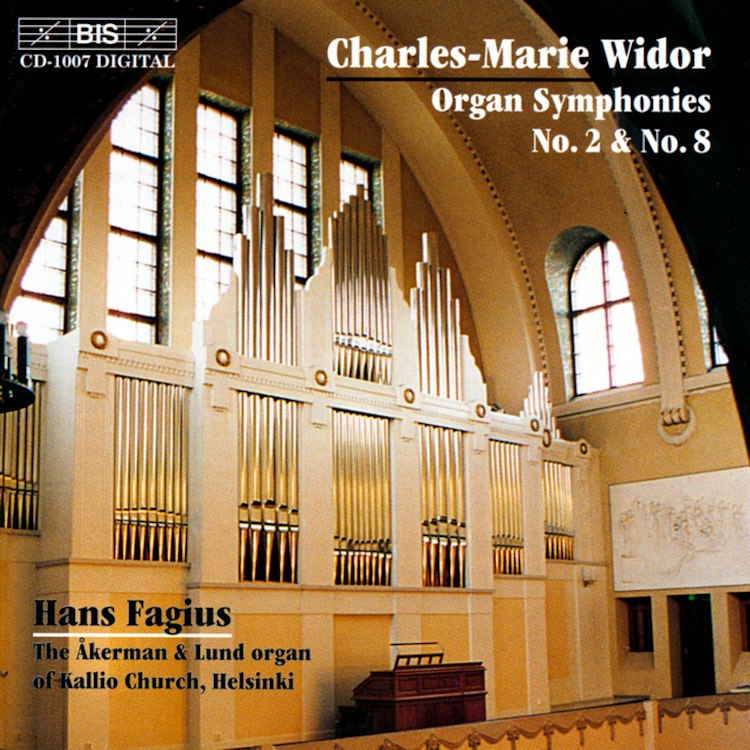
Widor: Organ Symphonies Nos. 2 in D Major and 8 in B Major
11/1/2000, 12 Tracks, 1:23:43
Featuring
Hans Fagius
Charles-Marie Widor
Did you know?
1/7
Instruments
Aristide Cavaillé-Coll, a pivotal organ builder, designed his instruments to expand the classical French baroque organ's sonority by incorporating orchestrally inspired registers and features for dynamic control.
Composer Biography
Charles-Marie Widor, a principal figure in the French symphonic organ tradition, was born in Lyon in 1844.
Recording & Production
This recording uses the final versions of Widor's symphonies from 1928-29, reflecting the composer's continuous revisions of his works.
Composition History
Widor is considered the creator of the French organ symphony, establishing the term with his Opus 13 in 1872, despite initial suspicion from critics.
Composer Biography
Widor studied organ with Jacques-Nicolas Lemmens in Brussels and composition with François-Joseph Fétis, but never attended the Paris Conservatoire, which sometimes caused him an inferiority complex.
Historical Context
The French symphonic organ tradition, in which Widor was a principal figure, originated in the mid-19th century and was largely created by organ builder Aristide Cavaillé-Coll.
Composer's Artistic Vision
Widor's first eight organ symphonies are rooted in orchestral symphonic music and are concert pieces free from liturgical aspects, unlike his later symphonies which incorporate Gregorian themes.
You might also enjoy...
Enjott Schneider – Sacred Music Vol. 3
Widor: Orgelsinfonien 5 & 10
Reger: Organ Works op.73 & op. 127
Max Reger: Organ Works
Mussorgsky, M.P.: Pictures at an Exhibition / 3 Movements From Petrushka
Reger: Das gesamte Orgelwerk, Vol. 2
Nowowiejski: Complete Organ Symphonies Vol. 1
Petrali: Organ Music
Karg-Elert: Organ Works, Vols. 5 and 6
Widor: Organ Symphonies No. 5-8 (Digitally Remastered)