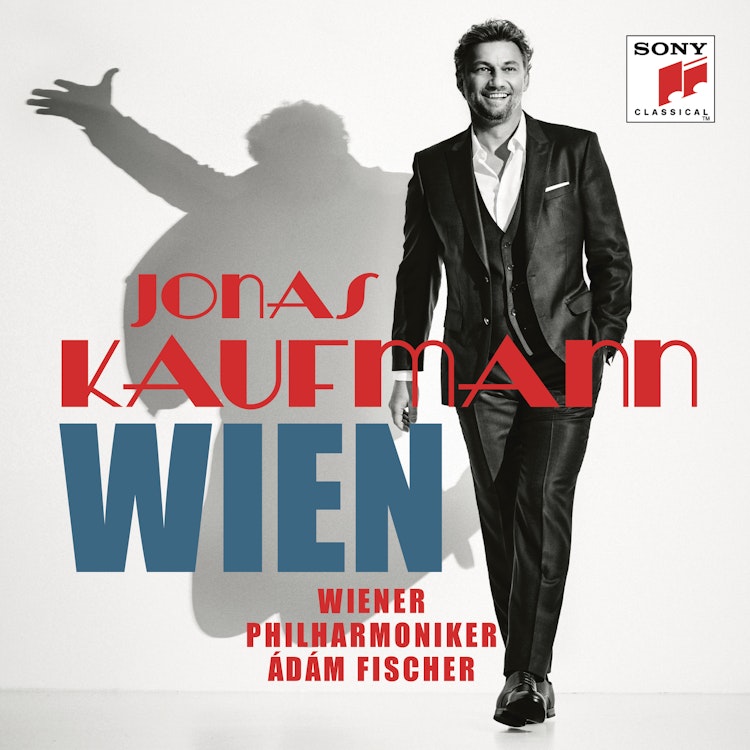
Jonas Kaufmann's personal tribute to Vienna's glorious tradition of waltzes and operettas is accompanied by Ádám Fischer and – of course – the Wiener Philharmoniker. This lovingly compiled collection includes extracts from operettas including Die Fledermaus, Wiener Blut and Die lustige Witwe, as well as many classic Viennese songs. Kaufmann is joined for several numbers by soprano Rachel Willis-Sørensen.
Featuring
Ádám Fischer
Jonas Kaufmann
Rachel Willis-Sørensen
Michael Rot
Wiener Philharmoniker
Robert Stolz
Rudolf Sieczyński
Hans May
Johann Strauss II (Jr.)
Franz Lehár
Emmerich Kálmán
Carl Zeller
Jaromír Weinberger
Hermann Leopoldi
Ralph Benatzky
Peter Kreuder
Georg Kreisler
Did you know?
1/7
Performer Biography
Jonas Kaufmann, the tenor on this album, spent much of his childhood on his grandparents' farm in Tyrol, where he watched Austrian TV and absorbed the Viennese dialect.
Composer's Artistic Vision
Jonas Kaufmann suggests that operetta, beyond comedy, also contains essential elements of unfulfilled dreams and yearning for the unattainable.
Performer Biography
Jonas Kaufmann's grandmother introduced him to operetta, as she loved the catchy tunes and singers like Rudolf Schock and Anneliese Rothenberger.
Historical Context
The album includes two songs from the 1935 Austrian film 'Heut ist der schönste Tag in meinem Leben,' starring Joseph Schmidt, which deliberately contrasted themes of joy and resignation.
Compositional Technique
The album features a diverse range of Viennese chansons, from richly orchestrated pieces to those for smaller ensembles like a salon orchestra, with vocal styles ranging from operatic to cabaret.
Interpretation
Jonas Kaufmann believes that the effort of singing, which can be effective in opera, is completely out of place in operetta; it must always sound relaxed and easy.
Cultural Impact
Jonas Kaufmann considers the album a 'cultural history of Vienna in notes,' showcasing the evolution of Viennese operetta and chanson.
You might also enjoy...
Enrico Caruso - The Complete Victor Recordings
Plácido Domingo - Album Collection
Jonas Kaufmann - The Tenor
Icon: Tito Gobbi
Giuseppe di Stefano - The Decca Recordings
Legendary Singers in Rare Live Broadcast Performances