In 18th-century Central Germany, "finely endowed" church music was a common tradition, enhancing religious services with cantatas for God's praise and the spiritual edification of the congregation.
Composer Biography
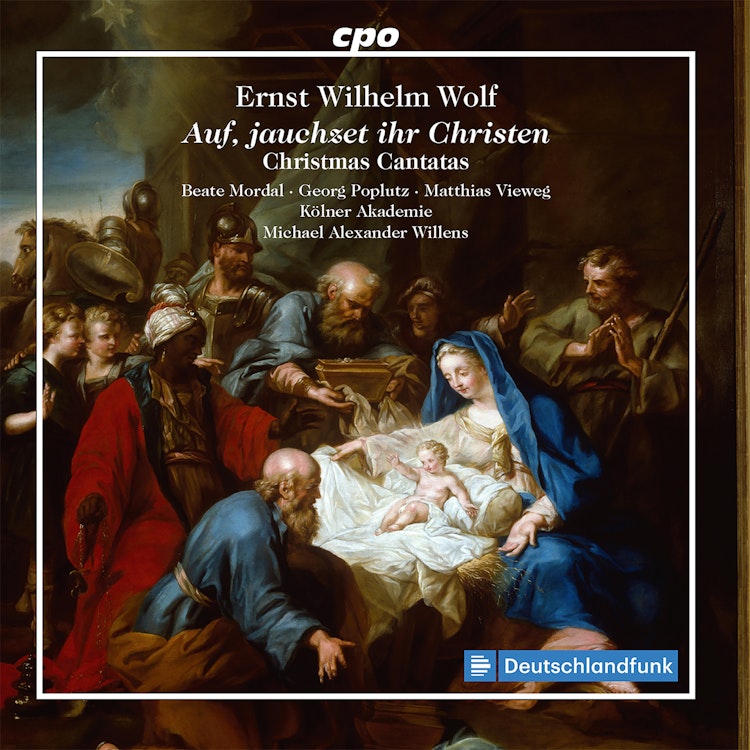
Ernst Wilhelm Wolf, the composer, showed great musical talent early on and became a choir prefect in secondary school, despite his father's wish for him to learn a trade.
Composer Biography
Wolf was hired by Duchess Anna Amalia, an avid musician and patron of the arts, as a piano teacher and eventually became court chapel master in Weimar, shaping its music life for over three decades.
Composition History
The cantata "Willkommen, du schönster der Tage" was originally an occasional composition from spring 1783, written to honor the newborn Hereditary Prince Carl Friedrich, with texts by Wieland and Herder.
Composer Biography
Wolf remained loyal to the Weimar court and Duchess Anna Amalia throughout his life, even turning down an offer from King Frederick II and the opportunity to succeed Carl Philipp Emanuel Bach in Hamburg.
Composer's Artistic Vision
Wolf was influenced by Carl Philipp Emanuel Bach and Carl Heinrich Graun but sought originality after Goethe's arrival in Weimar, stating, "you too must also seek to be original."
Composition History
The cantata "Willkommen, du schönster der Tage" was later adapted into a Christmas cantata, with a neutral second text or a Christmas text replacing the original dedication to the newborn prince.
You might also enjoy...
J.S. Bach: Christ unser Herr zum Jordan kam, BWV 7
J.S. Bach: Cantatas, BWVV 33, 17 & 99
J.S. Bach: O Ewigkeit, du Donnerwort, BWV 60
J.S. Bach: Falsche Welt, dir trau ich nicht, BWV 52
J.S. Bach: Erhöhtes Fleisch und Blut, BWV 173
J.S. Bach: Gott, wie dein Name, so ist auch dein Ruhm, BWV 171
J.S. Bach: Komm, du süße Todesstunde, BWV 161
J.S. Bach: Christen, ätzet diesen Tag, BWV 63
J.S. Bach: Nun komm, der Heiden Heiland, BWV 62
J.S. Bach: Erschallet, ihr Lieder, BWV 172
J.S. Bach: Ach Herr, mich armen Sünder, BWV 135
Bachkantate, BWV 49 - Ich geh und suche mit Verlangen (Live)
J.S. Bach: Wohl dem, der sich auf seinen Gott, BWV 139