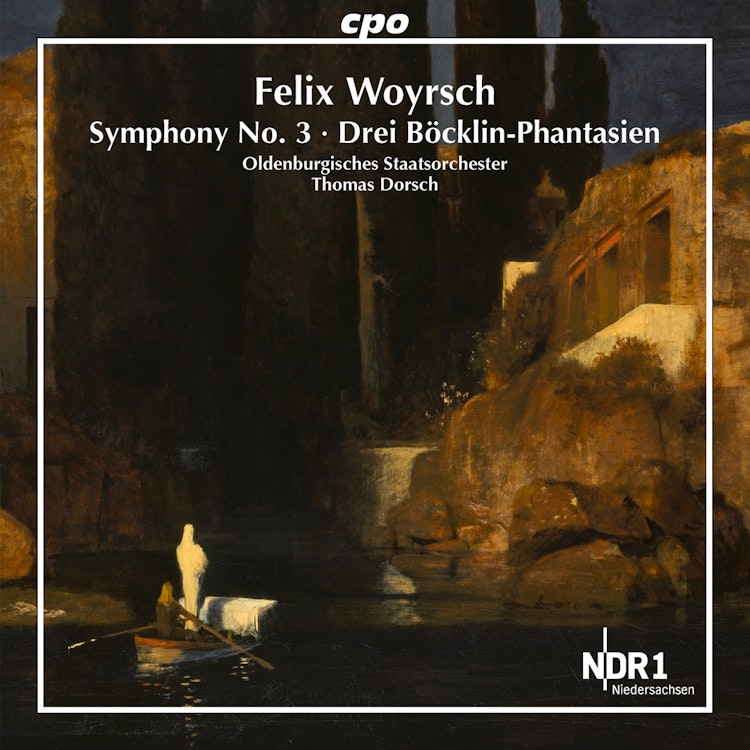
Woyrsch's "Böcklin Fantasies" were his most successful orchestral work, with over 20 performances across Europe between 1910 and 1913, and continued to receive public acclaim for decades.
Composer Biography
Woyrsch's musical talent was discovered at a fair where he performed as an "art piper," leading to free instruction from choirmaster Heinrich Chevallier.
Composer's Artistic Vision
Woyrsch considered himself an autodidact, humorously listing Palestrina, Bach, Beethoven, Mozart, Haydn, Schubert, Schumann, Brahms, Wagner, Berlioz, and German folk song as his "teachers."
Composition History
Woyrsch's Passion Oratorio op. 45 was a breakthrough work, discussed and frequently performed throughout Germany after its 1899 premiere, establishing him as a leading German composer.
Composer Biography
In 1914, the city of Altona created the position of "City Music Director" in Woyrsch's honor, which he held until 1931, acknowledging his central role in the city's music life.
Composition History
The Swiss painter Arnold Böcklin (1827-1901), especially his painting "Die Toteninsel" (The Island of the Dead), inspired about 20 different musical compositions, including works by Woyrsch and Rachmaninov.
Composer Biography
Felix Woyrsch (1860-1944) came from an old noble family, but his father died when he was six, leaving him without a financially secure childhood or formal musical training.
You might also enjoy...
Korngold: Another Dawn / Escape Me Never
Myaskovsky: Silence Op. 9 / Symphony No. 12
Glass, L.: Symphony No. 3, "Wood Symphony" / Symphony No. 6, "Birth of the Scyldings"
Vasilenko: Chinese Suite / Indian Suite
Myaskovsky: Symphonies Nos. 5 and 9
Korngold: Another Dawn / Escape Me Never
Vasilenko: Chinese Suite / Indian Suite
Glass: Complete Symphonies, Vol. 1
Hashimoto: Symphony No. 1 / Symphonic Suite
Myaskovsky: Silence Op. 9 / Symphony No. 12
Myaskovsky: Symphonies Nos. 5 and 9
Gerard Schurmann: Film Music
Erdman: Symphony No. 4 / Standchen / Monogramme
Smith, A.M.: Symphonies / Andante for Clarinet and Orchestra