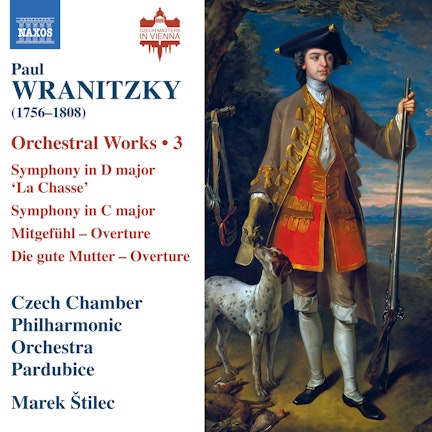
Paul Wranitzky (Pavel Vranický), born in 1756, received his first musical training at a Premonstratensian monastery in his home village of Neureisch (today Nová Říše, Czech Republic).
Composer Biography
Wranitzky became a Masonic brother with Mozart when three lodges merged in 1785, and a concert at the lodge that year included two symphonies by Wranitzky and works by Mozart.
Composer Biography
Wranitzky served as first orchestra director for both the Kärntnertortheater and Burgtheater in Vienna from the early 1790s until his death.
Critical Reception
After his sudden death in 1808, Wranitzky's musical legacy was quickly overshadowed by his colleagues and friends Mozart, Haydn, and Beethoven, and only recently has his music begun to regain attention.
Compositional Technique
Wranitzky was one of the most prolific symphonic composers of his day, with 45 surviving symphonies, and many features of his style are echoed in Beethoven's early symphonies.
Composer Biography
Joseph Haydn insisted that Wranitzky lead the orchestra for the profitable performances of his oratorio The Creation, and Beethoven requested Wranitzky to premiere his First Symphony in 1800.
Cultural Impact
Wranitzky's successful stage work, Oberon, König der Elfen, premiered in 1789, prompted Emanuel Schikaneder (the librettist and impresario) to launch a series of fairy-tale operas, including Mozart's The Magic Flute.
You might also enjoy...
ICON Sir Colin Davis
Wranitzky: Orchestral Works, Vol. 3
Mozart Festival: Prague Symphony, Symphony No.19, Magic Flute, The Marriage of Figaro
Festive Overtures - Handel, G.F. / Gluck, C.W. / Mozart, W.A. / Beethoven, L. Van / Weber, C.M. Von / Tchaikovsky, P.I.
Release 12: Mozart, Mahler And More
Bach, J.C.: Opera Overtures, Vol. 2
The First Recordings
Mozart Highlights
Beethoven: Symphony No. 3, Op. 55 "Eroica" - Schubert: Symphony No. 9, D. 944 "The Great" - Brahms: St Anthony Variations, Op. 56a