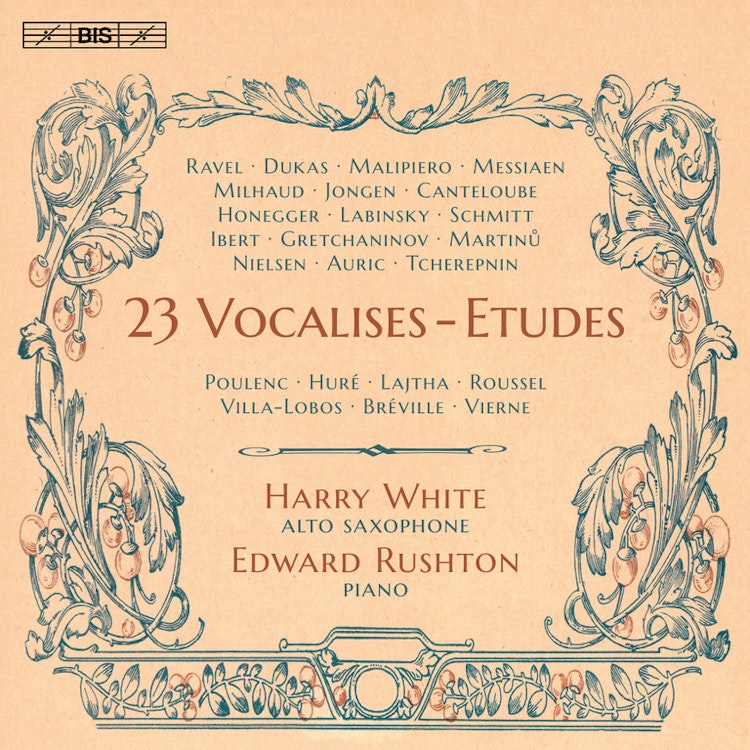
23 Vocalise-études (Arr. for Alto Saxophone & Piano)
6/3/2017, 23 Tracks, 1:07:39
Featuring
Harry White
Edward Rushton
Paul Dukas
Georges Auric
Francis Poulenc
Joseph Jongen
Olivier Messiaen
Arthur Honegger
Albert Roussel
Joseph Canteloube
Darius Milhaud
Pierre de Bréville
Florent Schmitt
Maurice Ravel
Louis Vierne
Jean Huré
László Lajtha
Alexandre Labinsky
Alexander Gretchaninov
Nikolai Tcherepnin
Bohuslav Martinů
Gian Francesco Malipiero
Carl August Nielsen
Heitor Villa-Lobos
Did you know?
1/7
Composition History
In 1906, Amédée-Landély Hettich, a voice professor at the Paris Conservatoire, began commissioning contemporary composers to write 'vocalises-études' to make vocalises more appealing.
Recording & Production
This recording features a Buescher Alto Saxophone 'Aristocrat', Series I, built in 1938, and a Steinway D Grand Piano.
Composition History
Over thirty years, Amédée-Landély Hettich persuaded many famous composers, including Aaron Copland, Darius Milhaud, Carl Nielsen, and Heitor Villa-Lobos, to write vocalises for his collection.
Composition History
The vocalises were commissioned by Amédée-Landély Hettich as examination pieces for voice students at the Paris Conservatoire.
Composer's Artistic Vision
Amédée-Landély Hettich's goal was to elevate the vocalise from a mere exercise to a work of art, calling it the 'fruitful mother of all embellishments'.
Instruments
The flexible, voice-like timbre of the saxophone makes it an ideal instrument for the varied musical characters found in Amédée-Landély Hettich's collection of vocalises.
Cultural Impact
Many of the vocalise-études from Amédée-Landély Hettich's collection have become popular in arrangements for various instruments, such as Ravel's for melody instruments and Roussel's for oboe.
You might also enjoy...
Preludes + Bagatelles
Tuba Europa: A musical journey through the continent