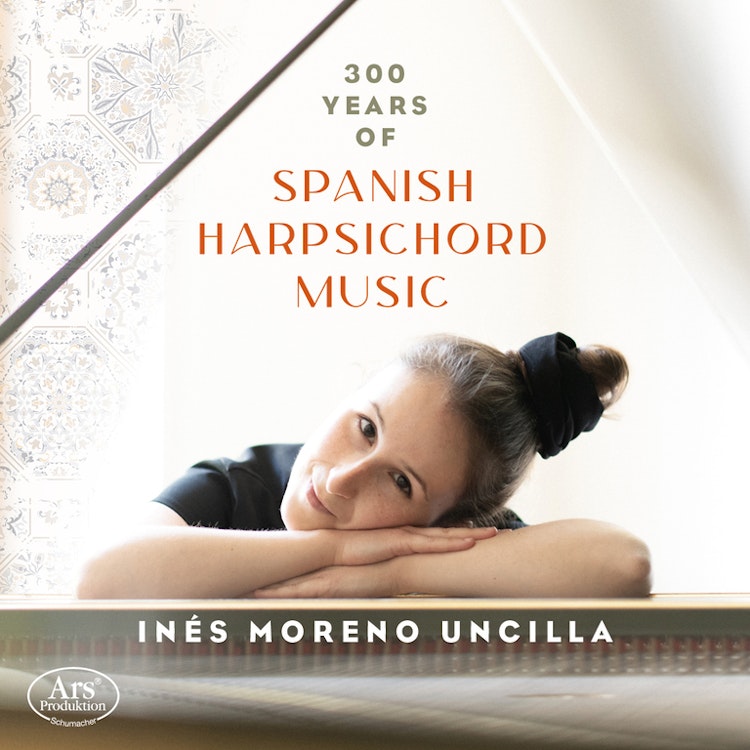
Inés Moreno Uncilla has won several awards, including first prize at the 92nd Juventudes Musicales España Competition in 2018 and second prize at the International Music Competition for Clavicembalo 'Paola Bernardini' in Bologna in 2019.
Composer's Artistic Vision
Early Spanish composers often drew inspiration from popular themes, songs, and dances, as well as melodies composed for liturgical purposes.
Interpretation
The recording uses two different temperaments: quarter-comma mean-tone temperament for the earliest instrument and Vallotti temperament for the other two, to suit the repertoire.
Recording & Production
The harpsichordist, Inés Moreno Uncilla, used three harpsichords from her teacher Andrea Marcon's private collection for this recording.
Performer Biography
Inés Moreno Uncilla, the harpsichordist, began her harpsichord studies at the age of eight at the Centro Integrado de Música Padre Antonio Soler in San Lorenzo de El Escorial.
Instruments
The album features three harpsichords, each a copy of an instrument from the relevant historical period, including a single manual harpsichord based on a 17th-century Italian model and a double manual harpsichord based on a 1730 Blanchet instrument.
Historical Context
Over the centuries from 1500 to 1800, the influence of Italian music gradually spread across the Iberian Peninsula, while Spanish music maintained its predilection for popular and folkloric elements.
You might also enjoy...
Music at the Time of Luca Giordano
English Harpsichord Works
Cromatica: The Art of Moving Souls – Works for Harpsichord
Airs of Edinburgh
A Treasury of Harpsichord Favorites
Bach, J. S.: Keyboard Music
Bach 333: Harpsichord Works
Clavichord Recital
Bach: 6 Concertos for Harpschord After Vivaldi
Baroque Harpsichord
La Spagnoletta, Selva di variazioni & diverse composizioni per il cimbalo
Seixas: Complete Works for Harpsichord, Vol. 1
Froberger: Suites de clavecin et Toccatas
Leonhardt Edition Vol.13 - J. Bull / J.J. Froberger