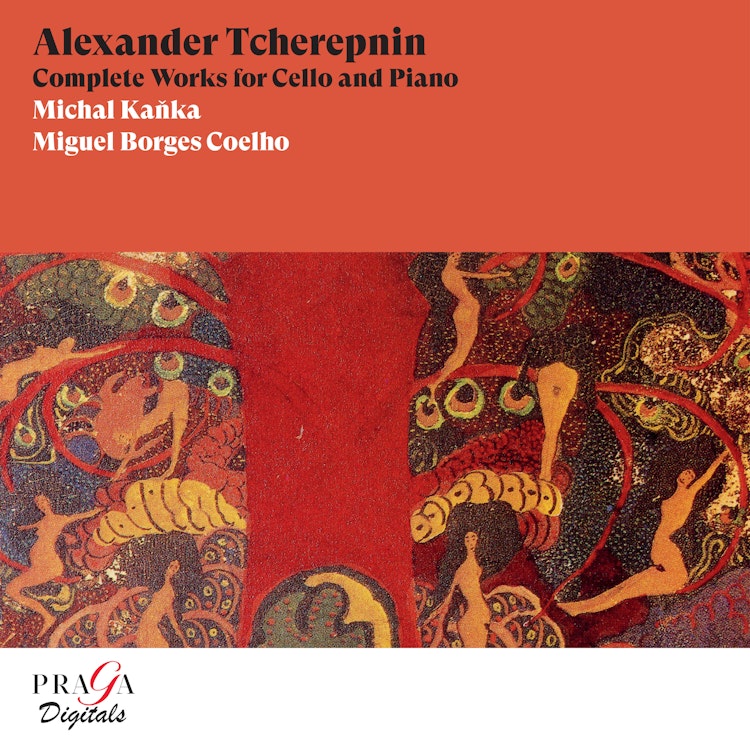
Alexander Tcherepnin: Complete Works for Cello and Piano
11/1/2012, 27 Tracks, 1:17:32
Featuring
Michal Kaňka
Miguel Borges Coelho
Alexander Tcherepnin
Did you know?
1/7
Composition History
The last cello cycle, Songs and Dances, was written for the renowned cellist Gregor Piatigorsky in 1954 and features arrangements of Georgian, Tartar, Russian, and Kazakh folk songs.
Composer's Artistic Vision
Tcherepnin promoted a technique called interpunctus or the 'between-note,' which adds rhythmic metamorphoses to polyphonic processes, ensuring independence of attacks and phrasings.
Performer Biography
Michal Kaňka, the cellist on this recording, won first prize at the Tchaikovsky Cello Competition in Moscow in 1982 and the Prague Spring Competition in 1983.
Composer Biography
Tcherepnin's talent was hereditary; his mother, Maria Benois, was a singer, and his father, Nikolai Tcherepnin, was a student of Nikolai Rimsky-Korsakov and teacher of Serge Prokofiev.
Compositional Technique
Tcherepnin's music is described as "minimalist" or "extremely thrifty" on a formal level, as he had a gift for modeling musical forms by eliminating useless details.
Compositional Technique
Tcherepnin developed a unique nine-interval scale (C-D flat-E flat-E sharp-F-G-A flat-A sharp-B natural-C) by adding three identical tetrachords, which confirmed the natural bimodalism of untempered music.
Composer Biography
Alexander Tcherepnin (1899-1977) was born in Saint Petersburg and became a "citizen of the world," active in music and education across Tbilisi, Paris, Shanghai, Tokyo, Chicago, and New York.