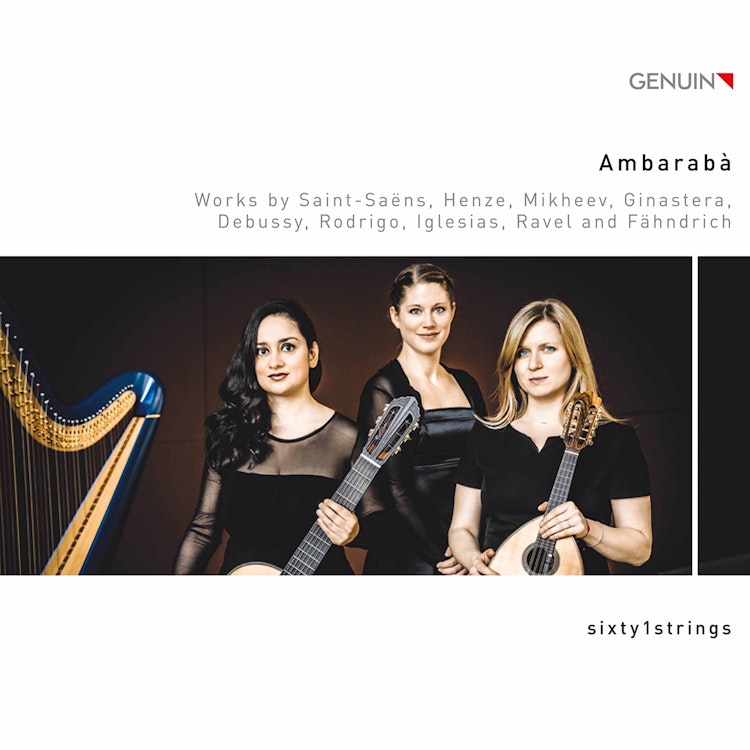
Ekaterina Solovey, the mandolinist of sixty1strings, originally studied the domra, a Russian folk instrument, before focusing on mandolin performance.
Instruments
Boris Mikheev's Seven Character Pieces, featured on this album, was originally written for the domra, a four-string Russian folk mandolin from the Caucasus region.
Composition History
The ensemble sixty1strings was formed in 2013, inspired by Hans Werner Henze's Carillon, Récitatif, Masque, which is the best-known original work for their instrument combination.
Album & Artwork
The album title 'Ambarabà' comes from an orally transmitted Italian nursery rhyme, which is quoted in the booklet.
Performer Biography
Konstanze Kuß, the harpist of sixty1strings, comes from a family of harp players and is the third generation to play the instrument.
Interpretation
The ensemble sixty1strings, consisting of harp, guitar, and mandolin, transcribes pieces from piano and orchestral literature, focusing on highlighting specific colors rather than just re-clothing the works.
Compositional Technique
Walter Fähndrich's Ambarabà, originally composed for synthesizer, uses a compositional formula that prevents any repetition, creating a permanent metamorphosis of iridescent eighth-note chains.