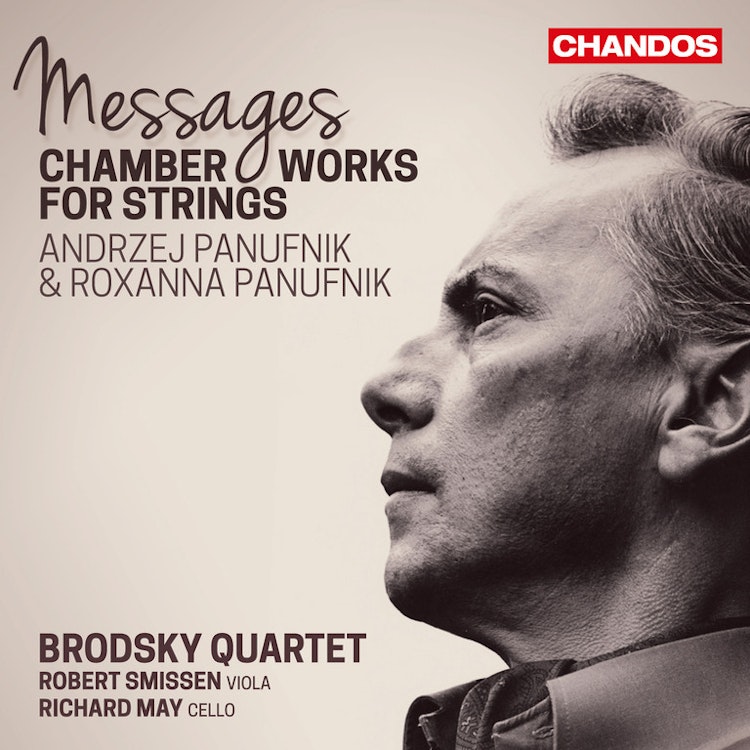
The piece 'Modlitwa' (Prayer) by Andrzej and Roxanna Panufnik, was originally a setting of the second stanza of a poem by Jerzy Pietrkiewicz, with the first stanza intended for narration.
Composer Biography
Andrzej Panufnik, a perfectionist, did not write a string quartet until his early sixties, considering it a significant challenge despite composing symphonies without fear.
Composer's Artistic Vision
Andrzej Panufnik's String Quartet No. 3, 'Wycinanki', was inspired by his lifelong love of intricate and symmetrical Polish paper cuts, which he described as having 'magical abstract beauty and naïve charm'.
Compositional Technique
Andrzej Panufnik's String Quartet No. 2, 'Messages', is based on a single four-note cell (tetrad) and a three-note cell (triad), which he likened to a 'secret code' of squares and triangles.
Historical Context
Andrzej Panufnik's 'Song to the Virgin Mary' was composed in Nazi-occupied Warsaw, a fact that stands in ironic contrast to its musical serenity.
Composer's Artistic Vision
The title of Andrzej Panufnik's String Quartet No. 2, 'Messages', alludes to his childhood pastime of listening to the semi-musical sounds of vibrating telegraph wires, which he considered the genesis of his compositional imagination.
Compositional Technique
Andrzej Panufnik's String Quartet No. 1 is dominated by the number three, with its movements tightly constructed upon a single triad.
You might also enjoy...
Uncovered, Vol. 3: Coleridge-Taylor Perkinson, William Grant Still & George Walker
Moeran: String Quartets / String Trio
Adès: The Twenty-Fifth Hour - Chamber Music of Adès