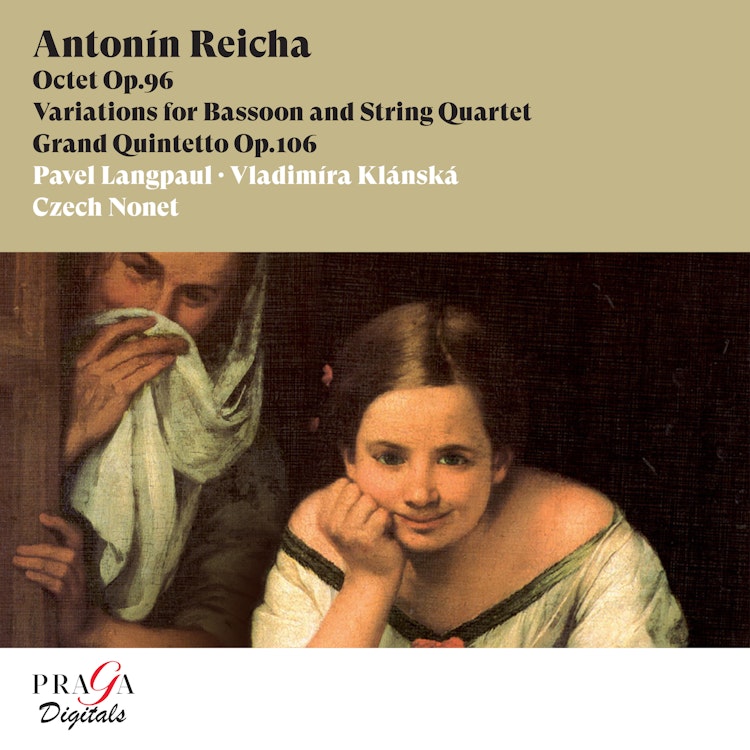
Antonín Reicha: Octet Op. 96, Variations for Bassoon, Grand Quintetto, Op. 106
1/1/2008, 9 Tracks, 1:10:44
Featuring
Vladislav Borovka
Aleš Hustoles
Pavel Langpaul
Vladimíra Klánská
Romana Zieglerová
Vladimír Kroupa
Simona Hečová
Radovan Heč
The Czech Nonet
Anton Reicha
Did you know?
1/7
Composer Biography
Antonín Reicha, a contemporary and friend of Beethoven's and protégé of Haydn's, was born in Prague in 1770 and is considered one of the earliest Czech composers of international rank.
Instruments
The 'Grand Quintetto' for horn and string quartet, Op. 106, was intended to be played on the hand horn, where pitches are adjusted by partially stopping the bell with the hand, rather than using valves.
Compositional Technique
Reicha was appreciated as a virtuoso of counterpoint, and his variation technique resembled that of middle and late Haydn, where themes retain their character while gaining astonishing dimensions through new instrumental colors and counterpoints.
Performer Biography
The Czech Nonet, founded in 1924 by Prague Conservatory students, is one of the oldest and most original chamber ensembles in the world, having inspired nearly 300 works by major composers.
Historical Context
In the early 19th century, Reicha was considered a specialist composer for woodwinds, similar to Danzi, and his Octet was known to Franz Schubert.
Compositional Technique
Reicha employed melodic models from his native folk music but clothed them in the forms of the Classical style, using neat phrase-lengths, plainer rhythms, and diatonic harmony.
Composer's Artistic Vision
Reicha, an early Romantic, celebrated music as a 'beautiful art intended to charm the soul and bring peace to the heart' and emphasized the importance of incorporating folk music.
You might also enjoy...
Takako Nishizaki Plays Suzuki Evergreens, Vol. 1
Souvenirs
Concertos
F. & C. Doppler: The Complete Flute Music, Vol. 5
Paganini: Duets for Violin and Bassoon / Cantabile in D Major / Rossini: Un Mot A Paganini
One Hundred Days Away
One Hundred Days Away
Wolfgang Amadeus Mozart: 6 Flute Sonatas K 10-15
Yehudi Menuhin, Vol. 2: Bach Sonatas for Violin & Harpsichord