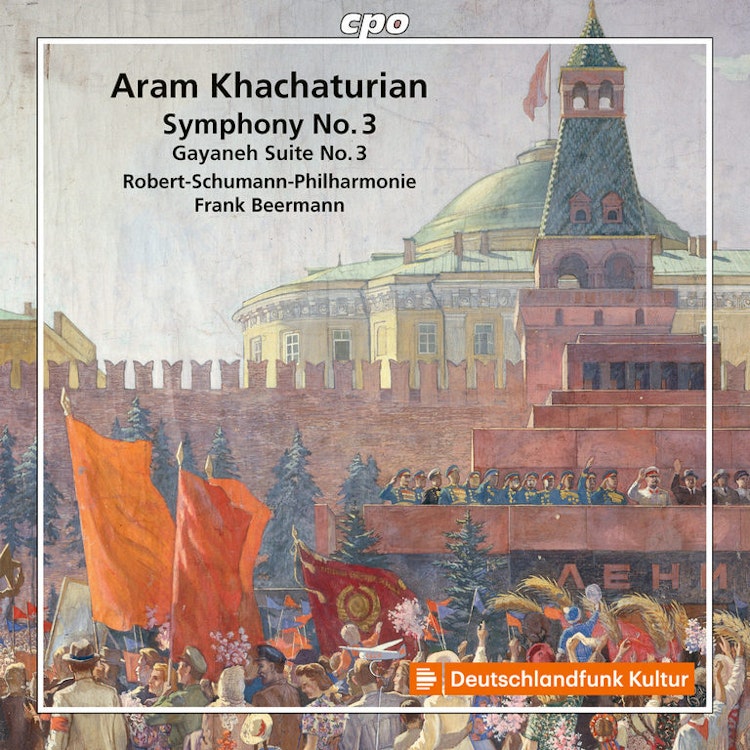
Khachaturian expressed sadness that all his other works stood in the shadow of his ballet Gayaneh, which became his most famous piece.
Composition History
The Symphony-Poem, initially a failure, was later revived and renamed the Third Symphony in 1963, finding a more receptive audience after the political "thaw" in the Soviet Union.
Historical Context
Khachaturian received numerous Soviet honors, including the Stalin Prize for his Violin Concerto and the ballet Gayaneh, but these did not guarantee artistic freedom.
Historical Context
In January 1948, a cultural purge led by Andrei Zhdanov targeted Soviet composers, including Khachaturian, Shostakovich, and Prokofiev, for "antiformalist" deviations.
Critical Reception
Khachaturian's Symphony-Poem, premiered in 1947, was initially met with mixed and largely negative reception, with critics finding it monotonous, ponderous, or imitative of "modern models."
Composer Biography
Aram Khachaturian, the composer, was a "compositional late bloomer" who catapulted into the Soviet limelight with his first symphony in 1935 and piano concerto in 1937.
Composer's Artistic Vision
Khachaturian's orchestral works transformed native folk material into symphonic structures without sounding contrived, a feat that was difficult for previous Caucasian composers.
You might also enjoy...
Aram Khachaturian: Symphony No. 1 · Dance Suite
Khachaturian, A.I.: Symphony No. 2 / Gayane Suite No. 1