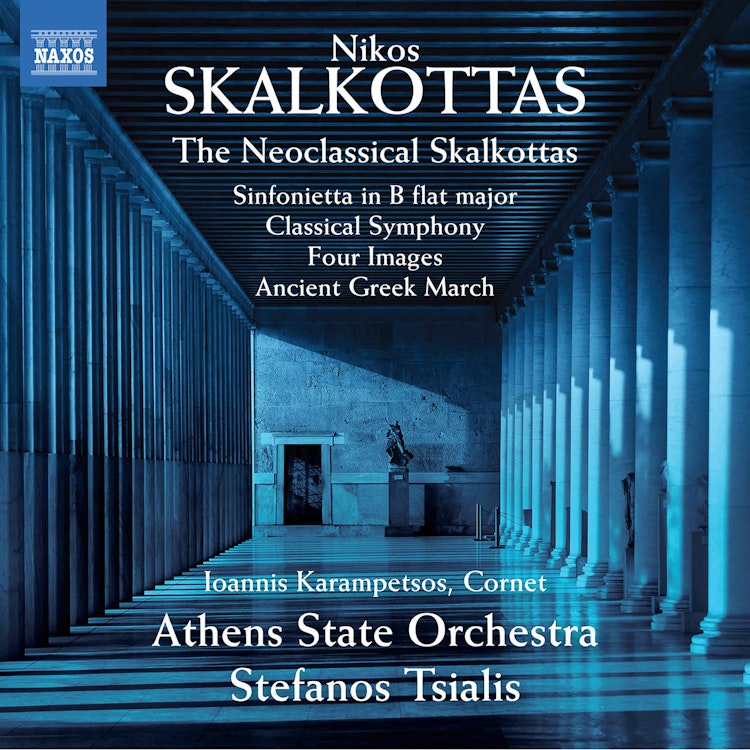
In the chamber orchestra version of the Ancient Greek March, Skalkottas used instruments like the flute and oboe (aulos), trumpet (salpinx), harp (lyre), and cymbals (cymbala) to evoke Greek antiquity.
Composition History
The Four Images originated from a dance suite for solo piano, commissioned by pianist Polyxene Mathéy, and were later reworked for symphony orchestra.
Composer's Artistic Vision
Skalkottas is considered Greece's leading neoclassical composer, despite a common perception of him as solely a 'modernist' or 'national' composer.
Composer's Artistic Vision
In his later works, Skalkottas consciously adopted a 'highly restrained' style, abstractly applying various idioms like tonal, atonal, expressionism, and folk music to reach a wider audience.
Compositional Technique
Skalkottas often recycled musical ideas, even using the beginning of an atonal theme from an 18-year-earlier concerto in the Finale of his Classical Symphony.
Composer Biography
Nikos Skalkottas, the composer, worked as a violinist for the Athens State Orchestra from its formation until his sudden death.
Composition History
The Ancient Greek March was commissioned by the Lyceum Club of Greek Women, a historic educational and charitable organization, to be played during processions representing ancient Greek eras.
You might also enjoy...
Hindemith Conducts Hindemith
Pierre Monteux: The Early Recordings 1941 - 1942
Farkas: Orchestral Music, Vol. 6
Reynolds, A.: Alice Through the Looking Glass Suite
Reynolds, A.: Alice Through the Looking Glass Suite
Finlandia - Works by Alfvén & Sibelius & Grieg
Lalo: Namouna Suite No. 1; Le Roi d'Ys Overture / Chausson: Symphony / Barraud: Offrande à une ombra
The Chicago Symphony Orchestra Recordings
Explosive Classics
Martinu: Orchestral Works
Honnegger: Symphonies Nos. 3, 5 & Mouvement symphonique No. 2