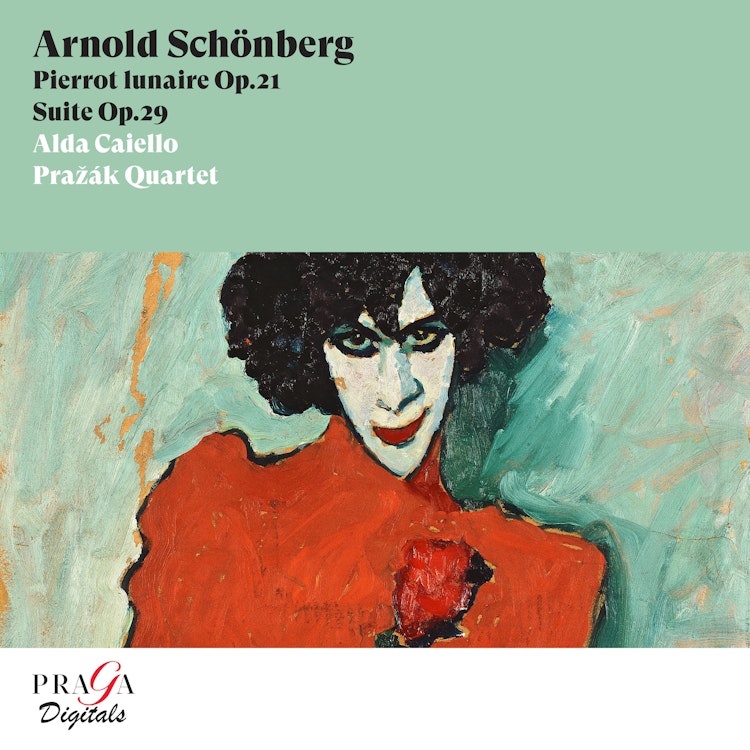
Arnold Schönberg: Pierrot Lunaire, Op. 21, Suite Op. 29
4/1/2012, 25 Tracks, 1:07:30
Featuring
Alda Caiello
Václav Kunt
Milan Polák
Vlastimil Holek
Johannes Meissl
Josef Klusoň
Michal Kaňka
Jaromír Klepáč
Karel Dohnal
Vít Spilka
Pavel Hůla
Arnold Schoenberg
Did you know?
1/7
Compositional Technique
Pierrot Lunaire is a suite of 21 'micro-melodramas' organized in groups of seven, featuring a 'reciter' accompanied by five versatile musicians who can change instruments.
Compositional Technique
The German adaptation of Albert Giraud's Pierrot Lunaire, by Otto Erich Hartleben, softened some crude imagery; for example, 'bloody spit' became 'a pale drop of blood'.
Composition History
Arnold Schönberg composed Pierrot Lunaire, Op. 21, in Berlin between March and September 1912, around the same time Stravinsky was working on The Rite of Spring and Debussy had just orchestrated Jeux.
Compositional Technique
The ensemble for Pierrot Lunaire (piano, flute/piccolo, clarinet/bass clarinet, violin/viola, and cello) corresponds to the 'chamber theatre' envisioned by the poet Albert Giraud in 1884.
Compositional Technique
Schönberg's Suite, Op. 29, written for an unusual combination of piano, three clarinets, and string trio, is part of a trilogy that applies his 'method of composition with twelve notes having no relation between them'.
Critical Reception
The premiere of Pierrot Lunaire in Berlin likely received little daily press attention because it coincided with the premiere of Richard Strauss's Ariadne auf Naxos, which garnered more focus.
Composition History
Pierrot Lunaire was inspired by actress Albertine Zehme, a 'teller' Schönberg met in Berlin, who suggested the idea of a melodrama and for whom the work is dedicated.
You might also enjoy...
Partners
Yánez: Viajera del río (Arr. Assad for Voice and Guitar)
Salvatore Sciarrino: Quaderno di strada
Gershwin: Fantasy on "Porgy & Bess“ (Arr. for 4 Pianos by Benjamin Engeli & Stefan Wirth)
S. Clancy, 45 Minutes of Music on the Subject of Football