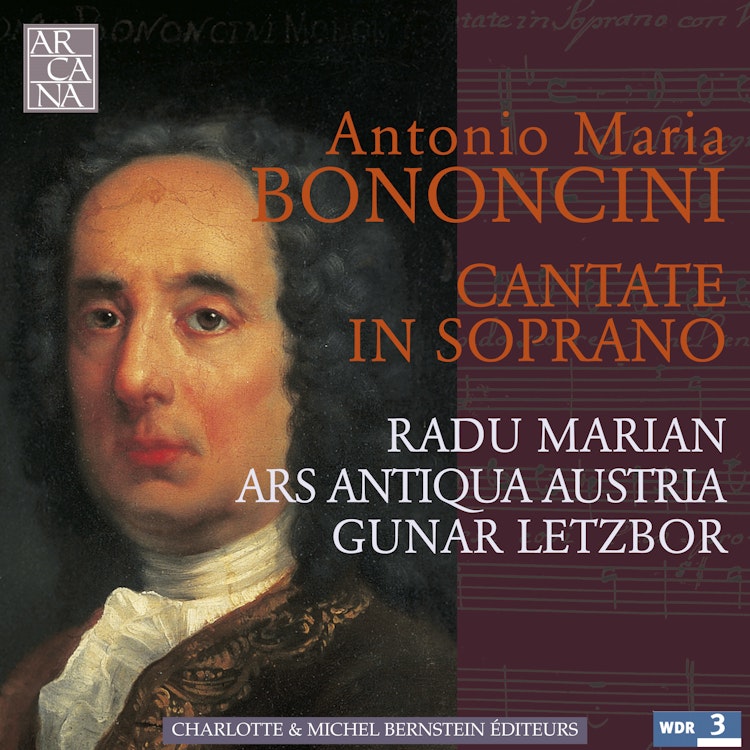
The revered theorist Padre G.B. Martini praised Antonio Bononcini's style as 'lofty, vivacious, affecting and delightful,' distinguishing him from most composers of his era.
Compositional Technique
Antonio Bononcini's cantatas are notable for their unusually long arias, which often surpass those of his contemporaries in length and complexity.
Historical Context
Antonio Bononcini was part of a generation of Italian composers who introduced the late Baroque style to Vienna at the beginning of the 18th century.
Composer Biography
Antonio Bononcini's principal instrument was the cello, and his earliest dated composition, a Laudate pueri (1693), features an elaborate cello obbligato part.
Compositional Technique
Antonio Bononcini consistently used obbligato instruments in all his cantatas, unlike other Viennese composers who used them only occasionally.
Composition History
The Italian secular cantata, after nearly forty years of neglect, began to flourish again at the Habsburg court around 1700, partly due to Emperor Joseph I's liberal education.
Composer Biography
Antonio Bononcini (1677-1726) initially modeled his career after his older, more famous brother, Giovanni Bononcini (1670-1747).
You might also enjoy...
José Marín, 1628-1699: Tonos Humanos
Evidence of Things Not Seen
Alexander Maria Wagner: Käfer töten - Lied Cycle
Manoury: Zeitlauf
Yánez: Viajera del río (Arr. Assad for Voice and Guitar)
Mahler: Das Lied von der Erde
Mahler: Das Lied von der Erde
Così amor mi fa languire
Ingenting forsvinner
October Skies - Songs for Tenor, Violin, Cello and Percussion