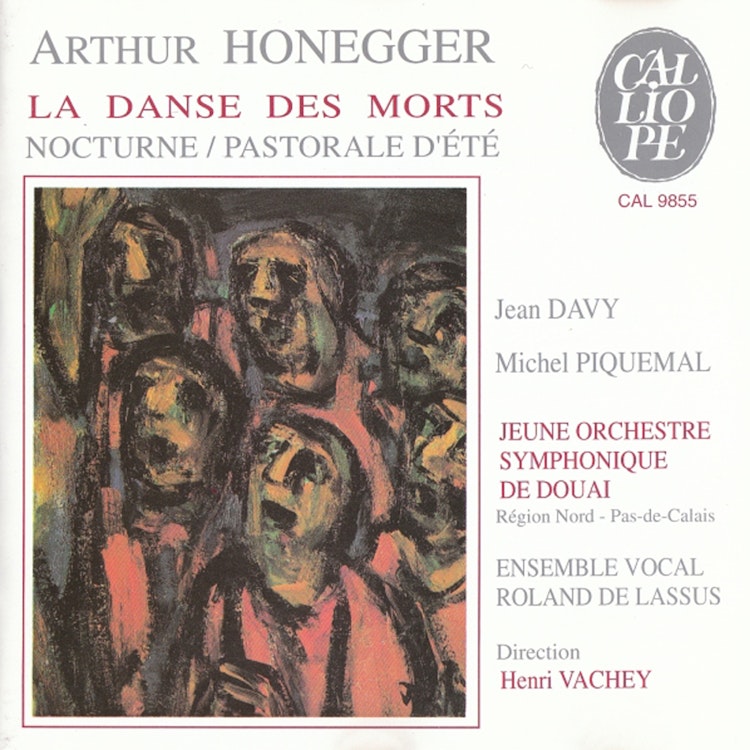
Arthur Honegger: La Danse des Morts / Nocturne / Pastorale d'été
5/2/2012, 9 Tracks, 48:46
Featuring
Jean Baquet
Jean Davy
Michel Piquemal
Claudine Collart
Henri Vachey
Douai Youth Symphony Orchestra
Roland de Lassus Vocal Ensemble
Arthur Honegger
Did you know?
1/7
Composition History
The idea for Honegger's La Danse des Morts originated when dramatist Paul Claudel, after seeing Holbein's "Danse Macabre" in Basle, was encouraged by Paul Sacher to write a new poem on the subject.
Composer's Artistic Vision
Honegger's works range from the innovative genius of his youth, seen in Horace Victorieux (1921), to his last work, Cantate de Noel (1953), which expresses a movement towards peace and serenity.
Composer Biography
Arthur Honegger, a complete musician of his generation, composed numerous works for voice and full orchestra, as well as thirty-three film scores and seven radio scores.
Compositional Technique
La Danse des Morts is structured in seven parts, a sacred number, arranged around the central figure of God, representing a struggle between matter and mind, death and life.
Notable Performances
La Danse des Morts, dedicated to Paul Sacher, was first performed in Basle on March 2, 1940, by its dedicatee leading the Basler Kammerchor and Basler Kammerorchester, and was an immediate success.
Compositional Technique
Honegger's Nocturne follows a plan with a peaceful first section, an agitated second section, and a third section that returns to calm, echoing the first with elements of the second.
Compositional Technique
Paul Claudel's text for La Danse des Morts, which inspired Honegger, included broad adaptations from the Bible, Ezekiel's vision, bits of Job, distorted folk songs, cries, sobs, and Latin phrases.
You might also enjoy...
Schnittke: Faust Cantata
Honegger: Symphony No. 4, Une Cantate de Noël, Pastorale d'été
Rihm, W.: Quid est Deus / Ungemaltes Bild / Frau/Stimme (Rihm Edition, Vol. 4)
Honegger : Le roi David
Hans Werner Henze: Drei sinfonische Etüden / +
Music from 6 Continents (1998 Series): A Peacock Southeast Flew
African Heritage Symphonic Series, Vol. 2
Messiaen, O.: Poemes Pour Mi / Les Offrandes Oubliees / Un Sourire
Kelemen: Archetypon Ii / Nonet / Die Richter
Dutilleux: Complete Orchestral Works
Dallapiccola: Orchestral Works
Takemitsu: Quotation Of Dream; Two Signals From Heaven; How Slow The Wind; Twill By Twilight; Archipelago S; Dream/Window