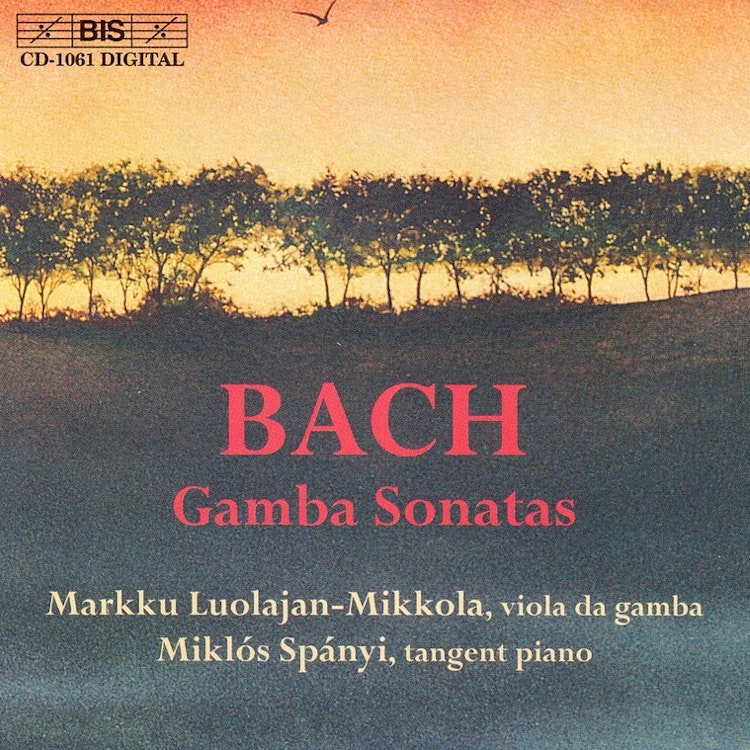
Bach, J.S.: Sonatas for Viola Da Gamba and Harpsichord
1/1/2001, 15 Tracks, 1:03:40
Featuring
Markku Luolajan-Mikkola
Miklós Spányi
Johann Sebastian Bach
Did you know?
1/7
Instruments
The tangent piano, used in this recording, is a descendant of the 'Pantaleon' instrument, known for its unique sonorities between a harpsichord and a modern piano.
Composition History
The sonatas for viola da gamba and harpsichord were not conceived as a unified group of works by Bach, and it is questionable if they are all original compositions for these instruments.
Compositional Technique
Bach frequently arranged works for different instrument combinations, a practice common and economical in the 18th and 19th centuries.
Historical Context
Bach used the viola da gamba as a solo instrument in the death arias of his St. John Passion and St. Matthew Passion, highlighting its intimacy and expressive intensity.
Performer Biography
Markku Luolajan-Mikkola, the viola da gamba player, was a founder member of the Phantasm viol quartet, which won a Gramophone Award in 1997.
Interpretation
This recording uses an early fortepiano, specifically a tangent piano, instead of a harpsichord, which is considered a historically 'correct' solution.
Instruments
The viola da gamba was considered better suited for chamber music than violins, which had an advantage in terms of sound quantity, according to Johann Mattheson's 1739 treatise.
You might also enjoy...
Buxtehude: Sonates - Reinken: Hortus Musicus
Dall'abaco and the Art of Variation
Duarte, Bull, Ferrabosco & Others: Chamber Works
Circa 1700: Purcell & his Generation
Cello Napoletano
Cello Napoletano
Transition baroque : Joseph Bodin de Boismortier (Trente et Unième œuvre & Œuvre Cinquantième)