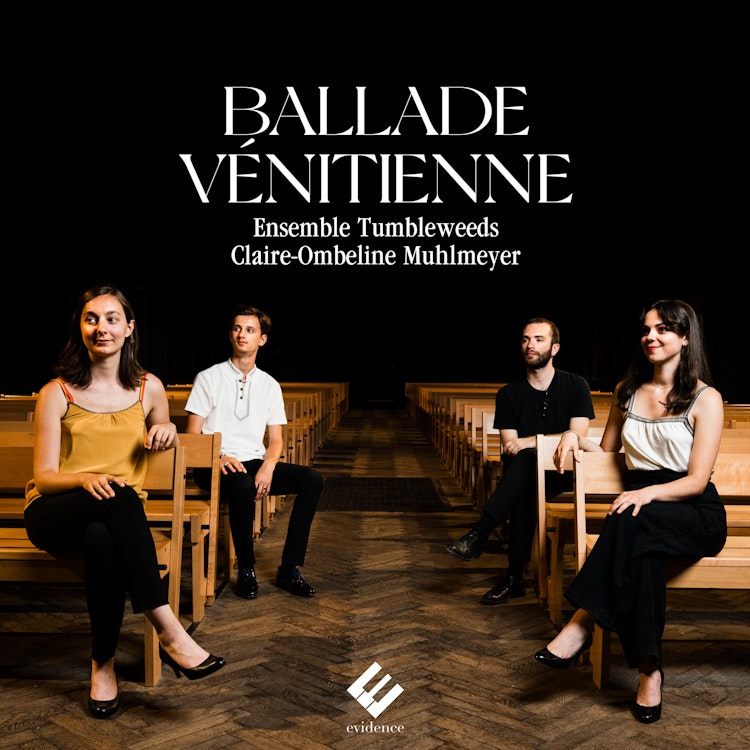
Venice, known as La Serenissima, was a hub of musical activity in the 17th century, attracting composers from across Italy, including Girolamo Frescobaldi, an organist based in Rome.
Instruments
The sackbut, a popular instrument at European courts, experienced its golden age in the 17th century, especially in Venice, where composers like Dario Castello gave it a highly virtuosic and soloistic role.
Interpretation
This recording features a continuo without keyboard or bowed bass, a natural choice for early 17th-century instrumental music, allowing each melodic line and improvised harmony to be heard distinctly.
Compositional Technique
Biagio Marini, a violinist at St Mark's Basilica, was one of the first to use scordatura, a technique that modifies the violin's original tuning to create new sonorities.
Interpretation
The Ensemble Tumbleweeds chose a two-stringed plucked basso continuo and two treble instruments, with the violin dialoguing with either the flute or, unusually, the sackbut.
Composer's Artistic Vision
Giulio Caccini, in his 1602 work Le nuove musiche, emphasized that the art of music tolerates no mediocrity and requires diligent study of music theory for competent performance.
Album & Artwork
The album title "Venetian Ballad" reflects the musical colors of 17th-century Venice between 1604 and 1660, a center for Renaissance and Baroque art.
You might also enjoy...
Sound the Trumpets
Bach: Sanguineus & Melancholicus
Alessandro Scarlatti: Baroque Influencer
Baroque
La Voce nel Violino
Rococo - Musique à Sanssouci
Recorder Concert (Italian): Haupt, Ekart – Fontana, G.B. / Mancini, F. / Vivaldi, A, / Bellinzani, P.B. / Barsanti, F. / Veracini, F.M.
Anthology of the Recorder, Vol. 6
Friedrich: The Trumpet Collection
Ostinato
Le Concert des Oiseaux. Vincent Bouchot: Le Carnaval des animaux en péril