Giulio Caccini, whose song 'Dalla porta d'oriente' opens the album, is considered one of the most important musicians in the transition from the Renaissance to the early Baroque and a co-founder of opera around 1600.
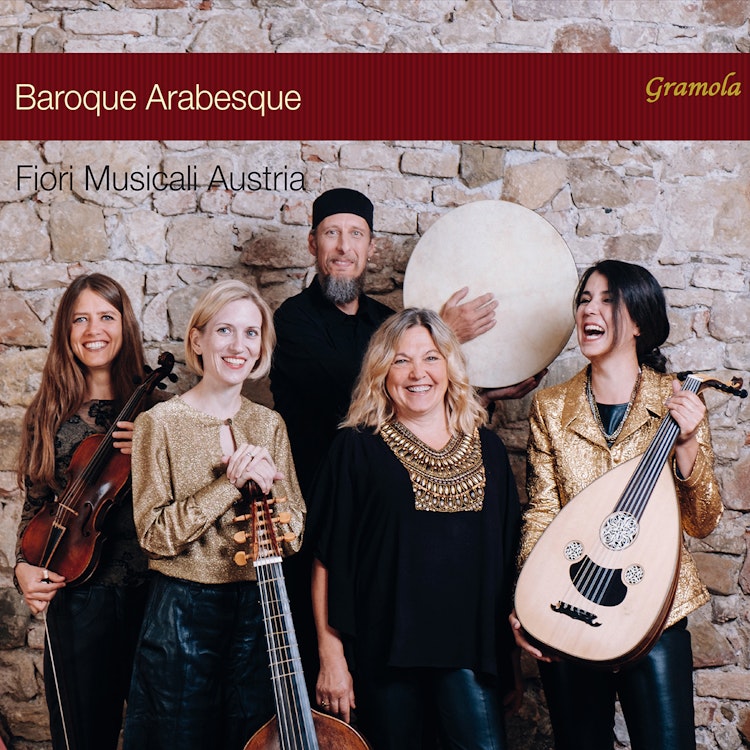
Album & Artwork
The album "Baroque Arabesque" explores the meeting points between Baroque music from Central and Southern Europe and oriental music, especially Sephardic culture from the Iberian Peninsula.
Historical Context
Sephardic music, which is a guiding principle of this album, originated with the Sepharadim, a group of European Jews primarily found in medieval Spain and Portugal who later spread to North Africa and other Mediterranean areas due to expulsion.
Interpretation
Fiori Musicali Austria, the ensemble on this album, combines traditional oriental instruments with historical Western instruments like the violin, viola da gamba, and harpsichord.
Compositional Technique
Sephardic music often features Arabic melodic modes (maqam), elaborately ornamented melodies, and rhythms adapted from regional folk music.
Composition History
Athanasius Kircher's 1641 textbook 'Antidotum Tarantulae' describes the Tarantella Napoletana, a southern Italian dance, and also provides a rhythmic antidote against a spider's bite.
Composer Biography
Athanasius Kircher, a German Jesuit priest, was a polymath who published extensively on subjects including mathematics, physics, astronomy, Egyptology, sinology, and music.
You might also enjoy...
Domenico Scarlatti: Sonatas (Arr. for Accordion)
Midsummer
Garlic & Onions
Vivaldi: Concertos
Pure - Works For Violin and Harpsichord By Bach, Corelli, Von Westhoff & Montanari
Charpentier: Incidental Music for "Circé" & "Andromède"