After World War I and the Treaty of Trianon, which dismembered Hungary, Bartók faced personal and professional pressure, leading to a period of compositional inactivity.
Composition History
Bartók's 13th and 14th Bagatelles, titled "Elle est morte" and "Valse: ma mie quie danse," hint at his relationship with young violinist Stefi Geyer, for whom he had written a violin concerto.
Composition History
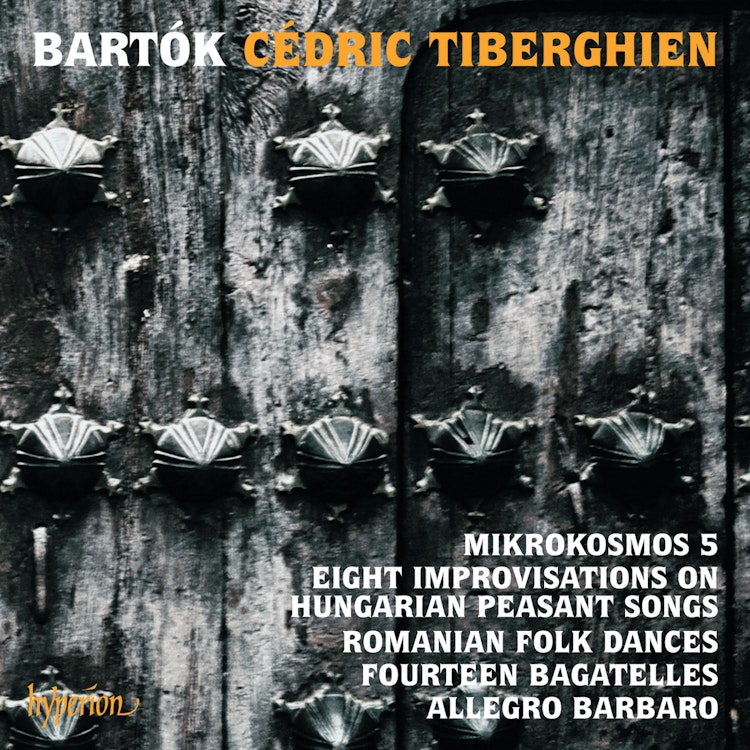
The penultimate improvisation of Bartók's Eight Improvisations on Hungarian peasant songs is a "tombeau" (memorial piece) for Claude Debussy, who died in March 1918, reflecting Debussy's significant influence on Bartók.
Historical Context
The title "Allegro barbaro" was chosen by Bartók to align himself with the spirit of Hungarian poet Endre Ady, whose poem "Echo of old songs" spoke of "ancient barbarism."
Composer's Artistic Vision
Béla Bartók's Fourteen Bagatelles (1908) introduced a new piano style that reacted against romantic piano music, stripped of decorative elements and using restricted technical means.
Compositional Technique
The very first of Bartók's Fourteen Bagatelles uses different key signatures for each hand (four sharps in the right, four flats in the left), making it one of the earliest examples of bitonality by a European composer.
Composition History
The Romanian Folk Dances, published in 1915, are Bartók's arrangements of folk melodies he collected between 1910 and 1912, and became one of his most popular pieces, especially in its orchestral version.
You might also enjoy...
Bartók: Piano Works
Bartók: Piano Works
Bartók: For Children & The First Term at the Piano
Zoltán Kocsis plays Bartók
Bartók: Complete Solo Piano Works
Bartók: Complete Works for Piano Solo, Vol. 3 – The Romantic Bartók
Bartók: Out of Doors & 7 Sketches & Two Elegies & 9 Little Piano Pieces