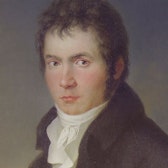
The String Quartet in C-sharp minor, Op. 131, was Beethoven's favorite of his late quartets, and he remarked that it contained 'a new manner of part-writing and, thank God, no less fantasy than before.'
Composition History
Beethoven's publisher, Mathias Artaria, convinced him to replace the original finale of Op. 130, the Große Fuge, with a new one due to its difficulty and length, publishing the fugue separately as Op. 133.
Compositional Technique
The Große Fuge (Op. 133) and other late quartets (Op. 127, 130, and 132) are thematically linked by the second tetrachord of the harmonic minor scale, arranged in different permutations.
Composer Biography
The third movement of Beethoven's Op. 132, titled 'Heiliger Dankegesang' (holy song of thanksgiving), is an autobiographical reference to his recovery from illness.
Compositional Technique
Beethoven's Op. 131, with its seven movements and continuous performance (attacca), challenged the expectations of 19th-century audiences who were used to applauding between movements.
Compositional Technique
Beethoven's late quartets, including Op. 130 and Op. 131, feature striking oppositions such as miniature movements placed alongside movements of great length.
Critical Reception
Beethoven's late quartets, including Op. 127, were initially met with ambivalence, with some listeners calling them 'vague' and 'chaotic' while others praised them as 'magnificent'.
You might also enjoy...
Beethoven: The Late String Quartets
Beethoven: The Late String Quartets
Beethoven: The Late Quartets
Beethoven : Late String Quartets Nos 12 - 16
Beethoven: The Late Quartets, Opp. 127, 130, 131, 132, 133 (Grosse Fuge) & 135