Beethoven's first published work in 1782 was 'Nine variations on a March by Dressel', and he continued to tackle the variation form throughout his career, composing some very large-scale works.
Composition History
Beethoven's Piano Sonata No. 12 in A flat major, Op. 26, was written in the same year as the 'Eroica' Variations, 1802, which was also the year his deep depression culminated in the Heiligenstadt Testament.
Composition History
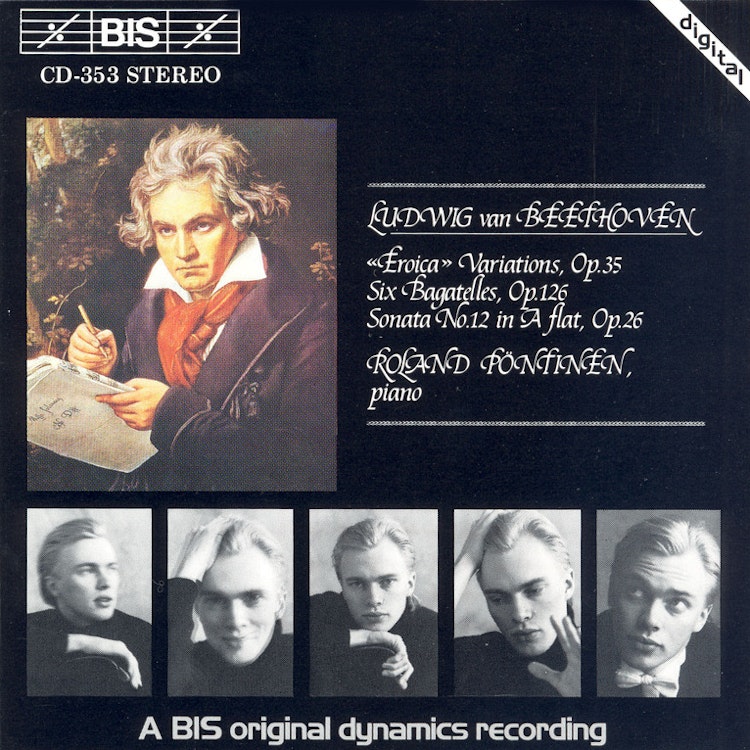
The theme for Beethoven's 'Eroica' Variations, Op. 35, which is recorded here, first appeared in his Twelve Contredanses from 1800 and then in the finale of his ballet music 'Prometheus'.
Composition History
The 'Eroica' Variations, Op. 35, were somewhat erroneously given their title, as the 'Eroica' Symphony, inspired by Napoleon, had not yet been written when they were composed in 1802.
Performer Biography
Roland Pöntinen, the pianist on this recording, made his debut at age 17 with the Stockholm Philharmonic Orchestra and has since toured extensively as a soloist and chamber musician worldwide.
Compositional Technique
Beethoven's Piano Sonata No. 12 in A flat major, Op. 26, is unusual for a sonata because it opens with a variation movement and does not contain a single movement in sonata form.
Composition History
Beethoven's Six Bagatelles, Op. 126, were written around the same time as his Ninth Symphony, between 1823 and 1824.
You might also enjoy...
Beethoven: 6 Bagatelles & Piano Sonatas Nos. 31 & 32
Beethoven: Piano Sonatas Nos. 18, 14, Für Elise
Beethoven - Complete Piano Sonatas
Beethoven: The Complete Piano Sonatas Played on Period Instruments
Beethoven: Sonatas
Brendel spielt Beethoven (Klavierkonzerte / Klaviersonaten)
Beethoven 2020 – Keyboard Works 1: Sonatas
The Art of Kazune Shimizu - Beethoven: Complete Piano Sonatas