One of today's leading string quartets plays the most celebrated set of string quartets ever written. The Brodsky Quartet's recording of Beethoven's final six quartets celebrates the great composer in the 250th year since his birth. Among his last compositions, these daring works encapsulate the visionary nature of late Beethoven.
Featuring
Daniel Rowland
Ian Belton
Paul Cassidy
Jacqueline Thomas
Brodsky Quartet
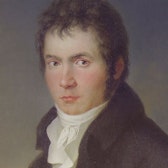
Ludwig van Beethoven
Did you know?
1/7
Composition History
Beethoven decided to remove the original long finale of String Quartet, Op. 130, and publish it as a separate work, the Große Fuge, Op. 133, after its first performance.
Composition History
Beethoven's late string quartets originated from a commission by Nikolas Galitzin, a 28-year-old Russian nobleman and amateur cellist, who requested one, two, or three new quartets in 1822.
Composition History
Beethoven's String Quartet, Op. 95 'Serioso,' was composed in 1810 but published in 1816, and despite its early date, it is often linked with his late quartets due to its textures, unusual forms, and striking musical gestures.
Composer's Artistic Vision
Beethoven's String Quartet, Op. 135, includes the inscription 'Der schwer gefaßte Entschluß: Muß es sein? Es muß sein!' (The Resolution Taken with Difficulty: Must It Be? It Must Be!), which highlights the relationship between the finale's slow introduction and its main theme.
Compositional Technique
Beethoven's String Quartet, Op. 131, rethinks the concept of a 'movement,' with some numbered sections serving as links rather than full movements, and the entire work played without pauses between sections.
Performer Biography
The Brodsky Quartet, formed in 1972, has performed over 3000 concerts and released more than seventy recordings, known for their mastery of traditional repertoire and pioneering work with diverse artists.
Composer Biography
Beethoven was extremely busy with other major projects, including the Missa solemnis and the Ninth Symphony, which delayed his work on Galitzin's quartet commission.
You might also enjoy...
BEETHOVEN, L. Van: String Quartets Nos. 11-16 / Grosse Fuge (Suske Quartet)
Beethoven: Late String Quartets
Beethoven: String Quartets Vol.3
Beethoven: The String Quartets, Live from Suntory Hall, Tokyo, Vol. 3