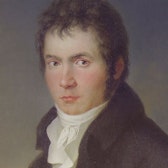
Before Beethoven, musicians were often considered servants, but after him, they began to pursue their careers autonomously, subject to market laws.
Compositional Technique
Beethoven's trills in his late sonatas, originally an improvisatory baroque ornament to sustain sound on the harpsichord, become fundamental elements of the formal architecture, transforming their role in piano music.
Compositional Technique
Beethoven's last three piano sonatas incorporate elements of vocal music, such as recitative and arioso, and attempt to make the piano sing beyond its material limits.
Instruments
The piano used for this recording is a Steinway D, serial number 594457.
Critical Reception
Richard Wagner, the famous 19th-century German composer, wrote in 1870 that Beethoven's deafness was a 'boon,' allowing him to surpass himself and attain an almost divine stature in his late works.
Critical Reception
Wilhelm von Lenz, a 19th-century commentator on Beethoven's music, did not consider Beethoven's Piano Sonata Op. 109 to be a masterpiece, finding its first movement weak and diffuse.
Recording & Production
This album was recorded by Little Tribeca from January 9 to 11, 2020, at Sala Gustav Mahler in Dobbiaco, Italy.
You might also enjoy...
Beethoven: Piano Sonatas Nos. 30, 31 & 32
Beethoven: The Last Sonatas
Beethoven: Piano Sonatas Op. 109, 110 & 111
Beethoven's Late Three Piano Sonatas
Beethoven: Piano Sonatas Nos 30, 31 & 32
Beethoven: Complete Piano Sonatas, Vol. 9
Beethoven: Piano Sonatas Nos 30, 31 & 32
Beethoven: Piano Sonatas, Vol. 9
Beethoven: Late Piano Sonatas, Opp. 109-111
Beethoven: Piano Sonatas, Opp. 109-111
nuovo vivente / Beethoven: Sonaten für Klavier Op. 109, 110, 111