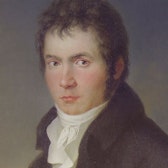
E.T.A. Hoffmann, a German Romantic author and composer, believed that Beethoven's instrumental music reveals the "realm of the monstrous and immeasurable."
Recording & Production
This album was recorded from January 7 to 10, 2012, at La Salle Philharmonique de Liège, Belgium.
Historical Context
The musicologist R.G. Kieseweter characterized the years 1800-1832 as "The Epoch of Beethoven and Rossini," highlighting the dual musical influences of the time.
Instruments
Beethoven used various pianos throughout his career, including an Érard from 1803 and a Broadwood from 1818, while also remaining loyal to Viennese instruments by Stein and Streicher.
Critical Reception
Hans von Bülow, a German conductor and pianist, was the first to perform Beethoven's complete cycle of 32 piano sonatas in a single evening in the second half of the 19th century.
Composer Biography
Beethoven, a native of Bonn, felt that Vienna was too Italian-influenced and not German enough.
Compositional Technique
Beethoven treated the piano acoustically, using contrasting registers, high trills, hand-crossing, and large pedals to release harmonies, moving from legato cantabile to percussive martellato.
You might also enjoy...
Beethoven: Piano Sonatas Nos. 30, 31 & 32
Beethoven: The Last Sonatas
Beethoven: Piano Sonatas Op. 109, 110 & 111
Beethoven's Late Three Piano Sonatas
Beethoven: Piano Sonatas Nos 30, 31 & 32
Beethoven: Complete Piano Sonatas, Vol. 9
Beethoven: Piano Sonatas Nos 30, 31 & 32
Beethoven: Piano Sonatas, Vol. 9
Beethoven: Op. 109, 110, 111
Beethoven: Late Piano Sonatas, Opp. 109-111
nuovo vivente / Beethoven: Sonaten für Klavier Op. 109, 110, 111