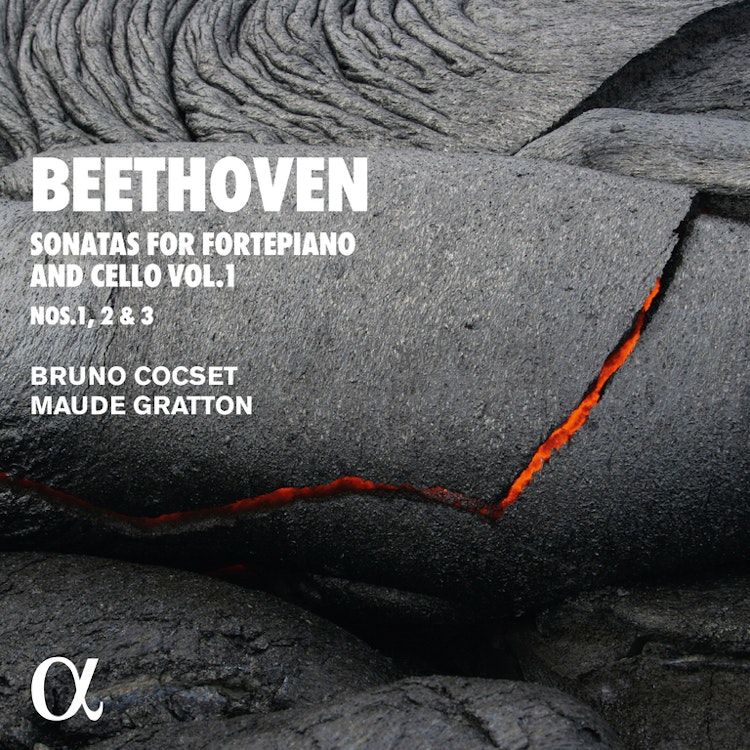
Beethoven: Sonatas for Fortepiano and Cello, Vol. 1
6/24/2022, 9 Tracks, 1:12:39
Featuring
Bruno Cocset
Maude Gratton
Ludwig van Beethoven
Did you know?
1/6
Instruments
The cello used in this recording was made by Charles Riché, based on one of Stradivari's late instruments, the 'Marquis de Corberon - 1726', a model often copied by Italian luthiers in the early 19th century.
Recording & Production
This album was recorded at La Ferme de Villefavard in Limousin, France, a converted granary known for its exceptional acoustics, designed by acoustician Albert Yaying Xu.
Compositional Technique
The first two cello sonatas by Beethoven, Op. 5 Nos. 1 and 2, are considered milestones for exploiting the rich qualities of both the cello and fortepiano, even if the keyboard part is amply scored.
Composer's Artistic Vision
Beethoven's music, influenced by the Sturm und Drang style, pushes boundaries by deviating from formal schemes and creating moments of uncontrolled frenzy or staggering void.
Composition History
Beethoven's first two cello sonatas, Op. 5 Nos. 1 and 2, were written for the French virtuoso Jean-Louis Duport and premiered in Berlin before the King of Prussia.
Instruments
For this recording, two different fortepianos are used to match the musical chronology and evolution of fortepiano building: a Gerard Tuinman after Johann Andreas Stein for Op. 5, and an original 1822 John Broadwood for Op. 69.
You might also enjoy...
Cello Sonata No. 3 in A Major, Op. 69: II. Scherzo. Allegro molto
Beethovens Kosmos
Down with Romanticism: Recital 1869 - Part 3
Beethoven: Complete Cello Sonatas
Beethoven: Six Sonatas for Cello and Piano
Beethoven: Cello and Piano Complete
Pablo Casals Plays Beethoven Cello Sonatas [Remastered]
Beethoven: 5 Cello Sonatas Live (Edinburgh Festival, 1964)
Ludwig van Beethoven: Cello Sonatas, Op. 69 & Op. 102