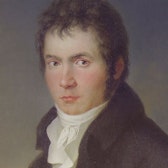
By the time of the third sonata's composition in 1808, Beethoven had already experienced significant misfortunes, including writing the Heiligenstadt Testament, and his advancing deafness increasingly focused his work on composing.
Album & Artwork
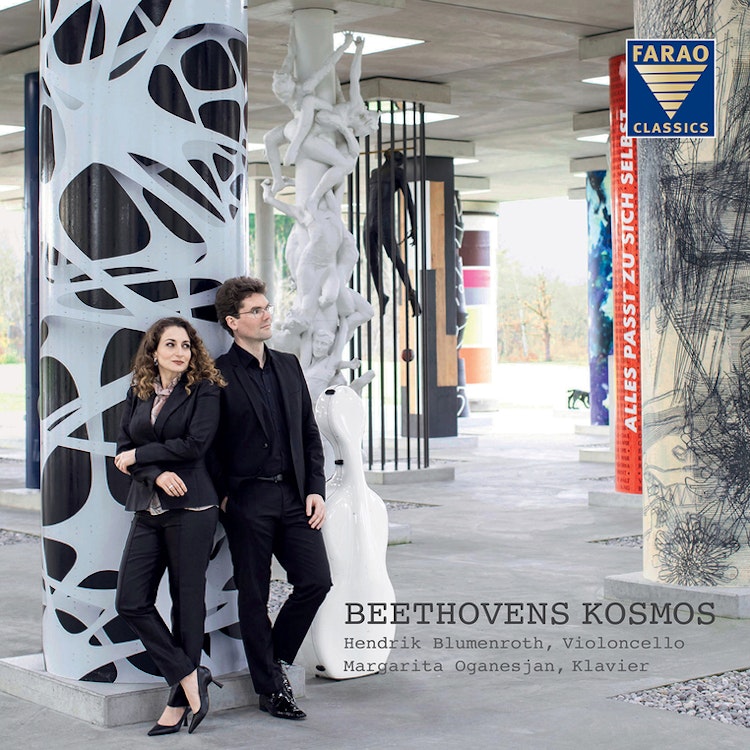
The album title, 'Beethoven's Cosmos', reflects how the five sonatas, written across three phases of Beethoven's life, offer a microcosm into his broader work and life.
Compositional Technique
In his late phase, marked by the Op. 102 sonatas, Beethoven's musical language became more original, experimenting with form, reducing virtuosity, and allowing the cello to develop its own voice, which likely disconcerted his contemporaries.
Compositional Technique
Beethoven's Op. 5 cello sonatas were revolutionary for their time, featuring the pianoforte and cello playing on an almost equal footing, unlike previous sonatas that typically featured cello with basso continuo.
Composer Biography
The fifth and final sonata is described as a 'true self-portrait' of Beethoven, featuring a 20-bar-long trill at the end of the fugue that could represent the tinnitus that plagued him.
Compositional Technique
The third sonata, Op. 69, begins with a cello solo, a 'cantabile phrase' that points towards Romanticism and achieves the equality between instruments that was only attempted in the earlier sonatas.
Album & Artwork
The album cover features the artwork STOA169 in Polling, a hypostyle hall with 121 columns, chosen for its combination of nature and art, and its representation of humanistic values like international solidarity and peace, which resonated with Beethoven's personality.
You might also enjoy...
Cello Sonata No. 3 in A Major, Op. 69: II. Scherzo. Allegro molto
Beethoven: Complete Cello Sonatas
Beethoven: Sonatas for Fortepiano and Cello, Vol. 1
Beethoven: Six Sonatas for Cello and Piano
Beethoven: The Conquering Hero – Complete Works for Cello and Piano
Beethoven: Cello and Piano Complete
Beethoven: Music for Cello & Piano
Pablo Casals Plays Beethoven Cello Sonatas [Remastered]