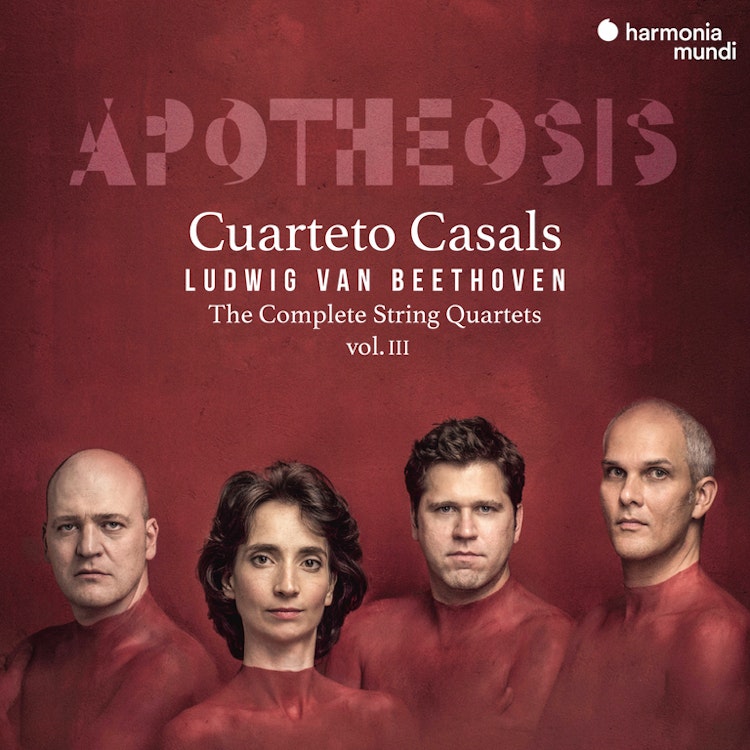
Beethoven: The Complete String Quartets, Vol. III "Apotheosis"
5/15/2020, 27 Tracks, 2:44:58
Featuring
Abel Tomàs Realp
Vera Martínez Mehner
Jonathan Brown
Arnau Tomàs Realp
Cuarteto Casals
Ludwig van Beethoven
Did you know?
1/7
Composer's Artistic Vision
Beethoven considered his String Quartet Op. 95 a 'quartetto serioso' and intended it only for 'a small circle of connoisseurs,' not public performance.
Composer Biography
Beethoven's creative output is often divided into three stylistic periods: a formative period (c. 1782-1802), a 'heroic period' (c. 1802-1812), and a late period (c. 1813-1827).
Composition History
Beethoven's String Quartet Op. 18 No. 5 was modeled after Mozart's Quartet K 464.
Composer's Artistic Vision
Beethoven believed that a 'truly poetic spirit' must enter the ancient form of the fugue, stating, 'It is no skill to write a fugue... But imagination also claims its rights.'
Compositional Technique
Beethoven's String Quartet Op. 130 originally concluded with the monumental Grosse Fuge, Op. 133, but he later composed a new, more playful finale due to public incomprehension.
Composer's Artistic Vision
In his late period, Beethoven, trapped by deafness, sought an increasingly austere and internalized abstraction in his music.
Album & Artwork
This album, titled 'Apotheosis', is the final volume in a complete recording of Beethoven's string quartets by Cuarteto Casals.