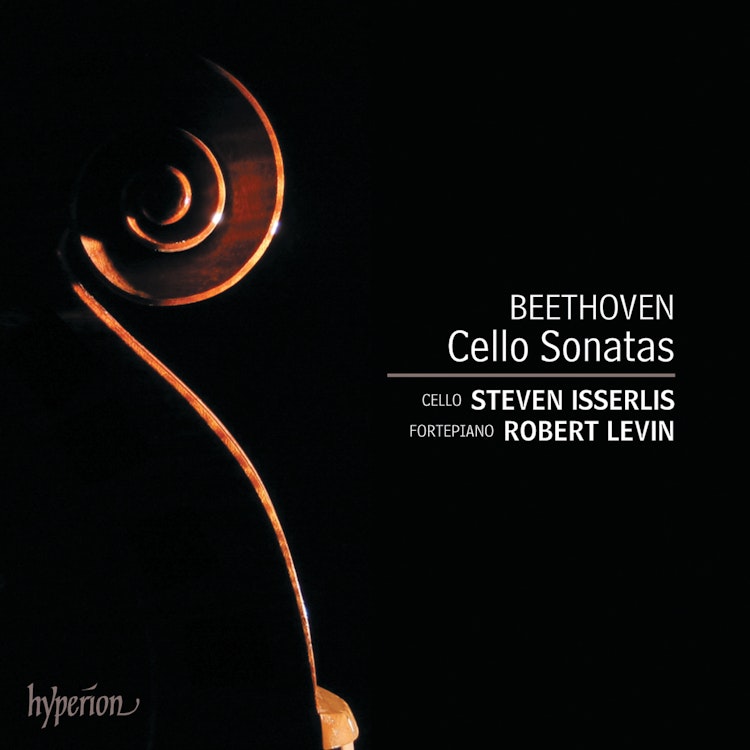
Beethoven: The Complete Works for Cello and Fortepiano
10/13/2023, 23 Tracks, 2:38:55
Featuring
Steven Isserlis
Robert D. Levin
Ludwig van Beethoven
Did you know?
1/7
Instruments
Steven Isserlis plays a 1726 Marquis de Corberon Stradivarius cello, on loan from the Royal Academy of Music, using an early nineteenth-century Tourte bow.
Compositional Technique
Beethoven's Op. 5 No. 1 Cello Sonata was groundbreaking as the first major cello sonata with a fully written-out keyboard part, rather than a basso continuo.
Composition History
Beethoven composed his Op. 5 cello sonatas in 1796 during a visit to the Berlin court of Friedrich Wilhelm II, King of Prussia, who was a keen amateur cellist.
Composer Biography
The five cello sonatas by Beethoven are unique among his works as they span all three of his major creative periods: early, middle, and late.
Historical Context
The Op. 102 Cello Sonatas were among Beethoven's first chamber works to be published in full score, with the cello line printed separately and above the piano part.
Instruments
Robert Levin performs on a Paul McNulty copy of a Walter & Sohn fortepiano from around 1805, featuring a five-and-a-half octave range and an una corda pedal.
Composer's Artistic Vision
Beethoven's Op. 69 Cello Sonata aimed for a truly equal duo, with material adaptable for either instrument, a departure from his earlier 'piano with cello obbligato' sonatas.
You might also enjoy...
Beethoven: Complete Music for Piano and Violoncello
Beethoven: Sonatas and Variations for Cello and Piano
Beethoven: The Cello Sonatas
Beethoven: The Complete Music for Cello and Piano
Beethoven: Complete Works for Cello & Piano
Beethoven, L. Van: Cello and Piano Music
Beethoven: Intégrale des Sonates et Variations pour violoncelle et piano