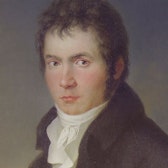
Beethoven: The String Quartets, Live from Suntory Hall, Tokyo, Vol. 2
3/27/2020, 20 Tracks, 2:41:11
Featuring
Jana Kuss
Oliver Wille
William Coleman
Mikayel Hakhnazaryan
Kuss Quartett
Ludwig van Beethoven
Did you know?
1/7
Compositional Technique
Beethoven's original finale for String Quartet No. 13 in B flat, Op. 130, was the demanding Grosse Fuge (Op. 133), but he later composed a less strenuous replacement at his publisher's request.
Compositional Technique
The 'Razumovsky' Quartets (Op. 59) were commissioned by Count Razumovsky, the Russian ambassador to Vienna, who requested that Beethoven include a Russian theme in each work.
Recording & Production
The Kuss Quartet's complete Beethoven quartet recording was made live in Tokyo's Suntory Hall, a major undertaking that required precise coordination and planning.
Composer's Artistic Vision
Beethoven's quartets are described by Jana Kuss of the Kuss Quartet as music that should provoke, not relax, acting as a "wedge suddenly and indecorously hammered into the consciousness of civilizations."
Instruments
The Kuss Quartet performed this entire Beethoven cycle on four 'Paganini' Stradivari instruments, loaned by the Nippon Music Foundation.
Composition History
Beethoven composed his Op. 18 String Quartets between 1798 and 1800, commissioned by Prince Joseph Franz Lobkowitz, a generous patron who also received the dedication of the 'Eroica' Symphony.
Interpretation
The Kuss Quartet aimed for a new level of spontaneity and relevance in their Beethoven performances, embracing unexpected musical choices and quick reactions during rehearsals and concerts.