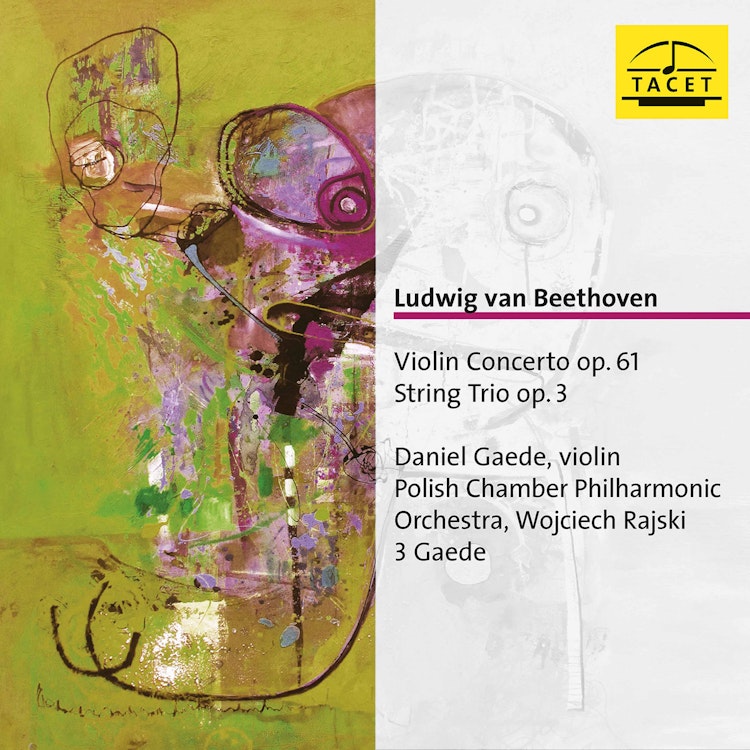
Beethoven: Violin Concerto in D Major, Op. 61 & String Trio in E-Flat Major, Op. 3
2/7/2020, 9 Tracks, 1:25:16
Featuring
Daniel Gaede
Sebastian Gaede
Thomas Gaede
Wojciech Rajski
Polish Chamber Philharmonic Orchestra Sopot
Ludwig van Beethoven
Did you know?
1/7
Critical Reception
Beethoven's Violin Concerto, now frequently performed, was initially criticized in 1806 for "incoherent and overcrowded ideas" and "endless repetition."
Composer's Artistic Vision
Beethoven's early chamber works, including the String Trio op. 3, were influenced by his high regard for the works of Haydn and Mozart, despite his exaggerated claim of learning "nothing from Haydn."
Recording & Production
The TACET Real Surround Sound recording philosophy focuses all efforts of the musicians and sound engineer on a single listener: you.
Compositional Technique
Beethoven's Violin Concerto features an unusually long first movement, spanning 535 bars, and gives the orchestra an equal partnership with the solo violin.
Composition History
Beethoven's String Trio op. 3, his first chamber music work purely for strings, was completed in 1794 when he was in his mid-twenties, despite its early opus number.
Compositional Technique
The Violin Concerto begins unusually with a central "tapping" motif in the timpani, which acts as an insistent driving pulse throughout the first movement.
Recording & Production
This album utilizes TACET Real Surround Sound, which aims to use the entire acoustic space for the musical experience, rather than confining music to two front speakers.