Berlioz completed his Requiem in just three months, but its premiere was cancelled by the government, leading to a struggle for payment and rescheduling.
Composer's Artistic Vision
Berlioz considered his Requiem his most important work, stating that if he had to burn all but one of his scores, he would plead for the Requiem to be spared.
Compositional Technique
Berlioz's Requiem is not a liturgical work; its length and vast forces made it unsuitable for a traditional church mass, and he took liberties with the traditional text.
Composition History
Hector Berlioz was commissioned in March 1837 to write his Requiem for 400 performers for a memorial service for those who died in the July Revolution of 1830.
Historical Context
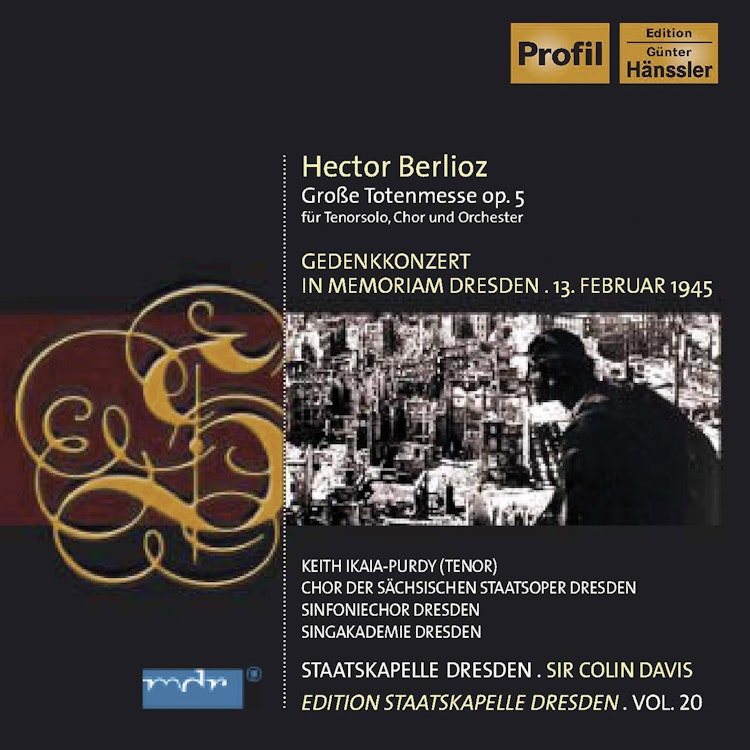
The concerts of February 13 and 14 in Dresden, including this recording, are dedicated to the victims of the city's destruction in the night of February 13-14, 1945.
Notable Performances
The premiere of Berlioz's Requiem took place on December 5, 1837, in Les Invalides in Paris, during the funeral of General Damrémont, who died in the Algerian campaign.
Performer Biography
Sir Colin Davis, the conductor on this album, was the first Englishman to conduct at the Bayreuth Festival, doing so in 1977 and 1978 for 'Tannhäuser'.
You might also enjoy...
Brahms: Ein deutsches Requiem: Classic Library Series