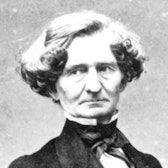
Berlioz frequently reused musical material from earlier works that had been rejected by the public or himself, incorporating them into new compositions.
Compositional Technique
The final movement of Harold en Italie employs a technique of parading previous themes, a device borrowed from Beethoven's Ninth Symphony, to musically unify the work.
Recording & Production
This recording utilizes 24-bit / 96 kHz technology, which offers a dynamic range up to 48 dB greater and 256 times the resolution of standard 16-bit recordings.
Performer Biography
James Ehnes, the violinist and violist on this recording, plays the 'Marsick' Stradivarius of 1715, on loan from Beare Violins, Ltd.
Composer Biography
Hector Berlioz, the composer, was a winner of the Prix de Rome, a prize instituted by the French Government to enable French artists to study in an environment of classical art.
Recording & Production
The recording was made in Hamer Hall, Arts Centre Melbourne, Australia, with sessions taking place in August and November 2014.
Composition History
The symphony Harold en Italie was commissioned by Niccolò Paganini, a virtuoso violinist, who admired Berlioz's Symphonie fantastique and wanted a piece to showcase his Stradivarius viola.
You might also enjoy...
Berlioz: Harold in Italy - Paganini: Sonata per la Grand Viola e Orchestra
Berlioz: Harold in Italy / Les Francs-Juges
Berlioz: Harold In Italy; Le Carnaval Romain - Overture
Berlioz Overtures / Queen Mab Scherzo
Berlioz: Harold en Italie
Saint-Saëns: Samson and Delilah Fantasy, La Jota Aragonese, Tarantelle
Glinka: Capriccio Brillante / Overture in D Major / Souvenir D'Une Nuit D'Ete A Madrid
Late Romantics
Herold: Overture To Zampa / Gounod: Funeral March of A Marionette / Thomas: Overture To Mignon
Mussorgsky: Pictures at an Exhibition; Songs and Dances of Death; Khovanshchina: Classic Library Series
Bruckner: String Quintet in F Major (Arr. G. Schaller for Large Orchestra) & Overture in G Minor
Mussorgsky: Pictures at an Exhibition; Songs and Dances of Death; Khovanshchina: Classic Library Series