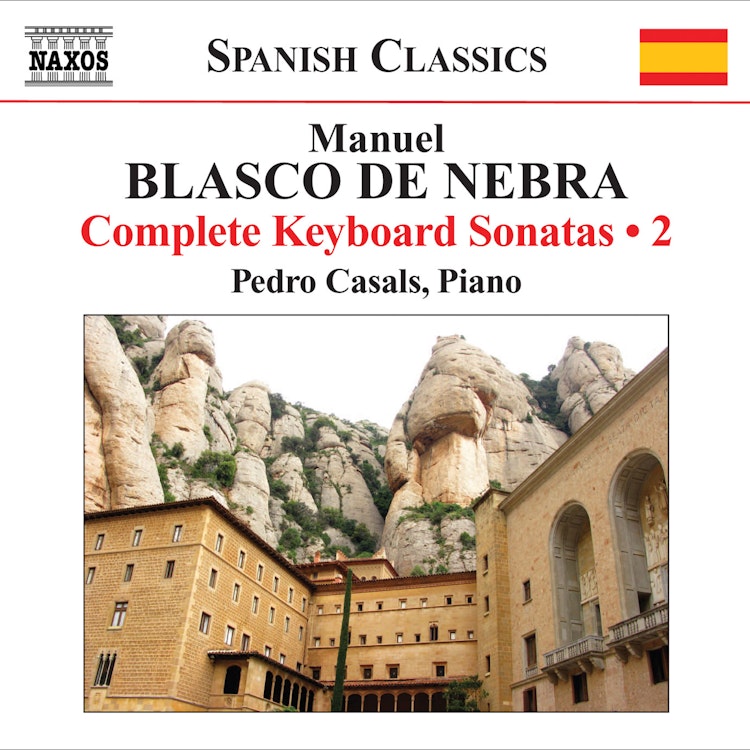
Blasco De Nebra, M.: Keyboard Sonatas (Complete), Vol. 2
5/17/2010, 15 Tracks, 1:15:47
Featuring
Pedro Casals
Manuel Blasco de Nebra
Did you know?
1/7
Composition History
Despite a reference by Baltasar Saldoni in his Diccionario de efemérides de músicos españoles to Manuel Blasco de Nebra writing 170 works, only 26 keyboard sonatas and six pastorellas are known today.
Composer Biography
Manuel Blasco de Nebra gained renown in Madrid for his exceptional sight-reading abilities and expressive performances on harpsichord, organ, and the then-new piano.
Composer Biography
Manuel Blasco de Nebra, born in Seville in 1750, came from a musical family, with his father, José Blasco de Nebra, an organist, serving as his first teacher.
Compositional Technique
Manuel Blasco de Nebra's fast movements in his keyboard sonatas often imitate the sound of the Spanish guitar, particularly the strumming effects.
Album & Artwork
This album is part of a three-disc collection that brings together all of Manuel Blasco de Nebra's surviving sonatas, organized chronologically to show the evolution of his work.
Compositional Technique
The composer's last sonatas, published as his Opus 1 in 1780, are the most technically and expressively challenging, pushing the limits of contemporary keyboard instruments.
Performer Biography
Pedro Casals, the pianist on this album, earned a doctorate in music from the Madrid Universidad Autónoma with research into the composer Manuel Blasco de Nebra.
You might also enjoy...
Dark Fires
Platti: Twelve Piano Sonatas
Blasco De Nebra, M.: Keyboard Sonatas (Complete), Vol. 1
Talma, Sessions, Cowell & Lybbert: Piano Works
Tishchenko: Complete Works for Piano, Vol. 1
Pabst: Paraphrases
Jeffrey Jacob performs Piano Music from 4 Continents
Széchényi: Piano Music from a Hungarian Dynasty, 1800-1920