The presence of two Credos in "Choro et Organo" confirms its anchoring in a 16th-century liturgical idea, despite a prohibition by Clement VIII in 1600 against alternatim performance of this part of the mass.
Composition History
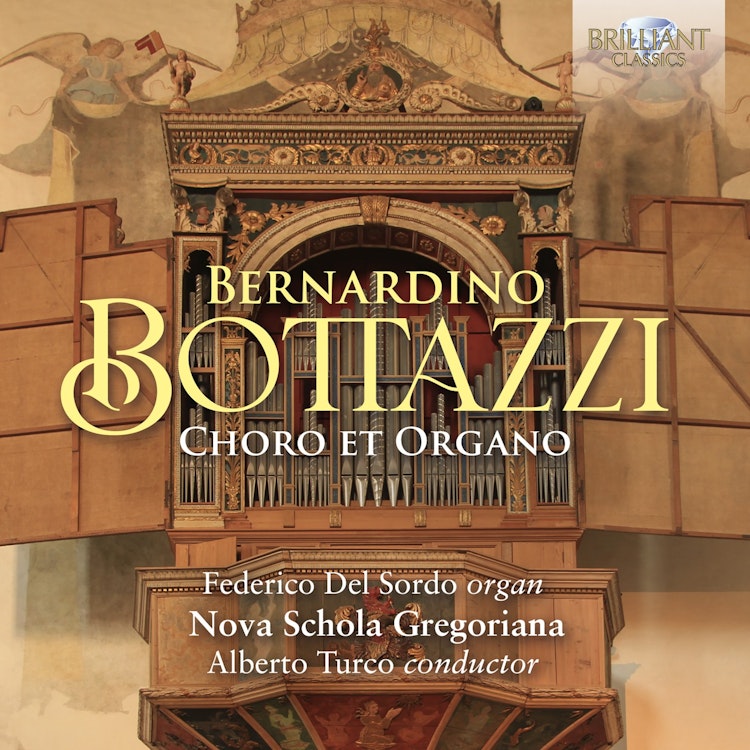
Bernardino Bottazzi's "Choro et Organo" (Venice, 1614) is considered the most extensive Italian collection of organ works for liturgy from the early 17th century.
Instruments
The organ used for this recording, located in the church of S. Bernardino da Siena, has an original core dating back to 1481, with its facade doors painted by Domenico Morone.
Composer's Artistic Vision
Bottazzi's "Choro et Organo" was strongly influenced by the didactic impulses of the Council of Trent, aiming to instruct organists in composition and improvisation.
Recording & Production
The album was recorded in August 2022 at the church of S. Bernardino da Siena in Verona, Italy, with the Franciscan community hosting the performers.
Compositional Technique
The collection includes an introduction with 18 'avvertimenti' (notices) illustrating principles of canonic counterpoint and suggestions for melodic diminution and embellishments.
Performer Biography
Federico Del Sordo, the organist, teaches at Conservatorio Santa Cecilia and the Pontifical Institute of Sacred Music in Rome, and has dedicated over fifteen years to studying alternatim repertoire.
You might also enjoy...
Piers Connor Kennedy: Advent Calendar
Stabat Mater
Münchner MotettenChor: Barock in blue (Motets inspired by Johann Sebastian Bach)
Bach/Höcherl/Sakas: Die Bach-Motetten Vol. III
Zielenski: Opera Omnia, Vol. 2 - Offertoria Totius Anni