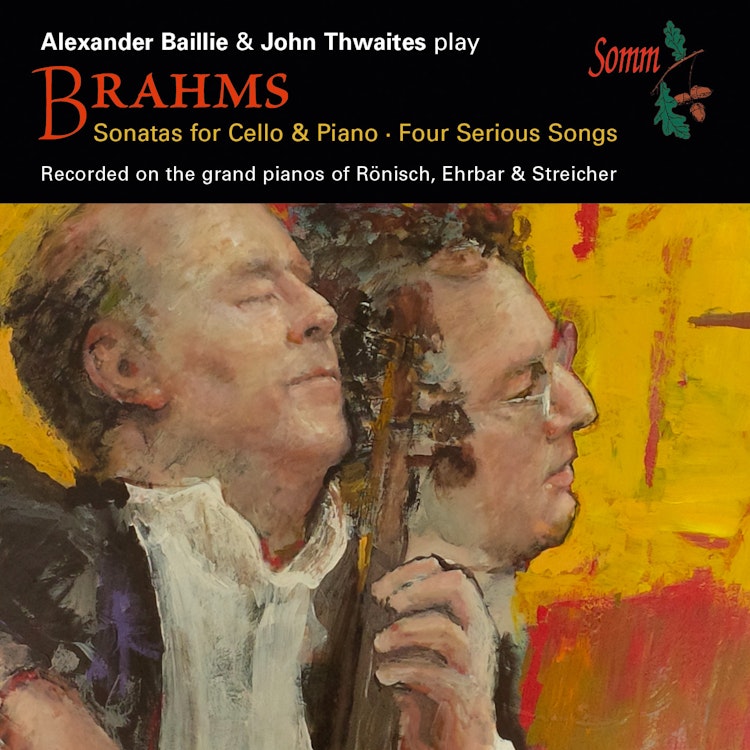
This recording was made at Gert Hecher Klavier-Athelier in Vienna, using three different grand pianos: a Rönisch for Op. 38, an Ehrbar for Op. 99, and a Streicher for the Four Serious Songs.
Compositional Technique
The fugal finale of Brahms's Cello Sonata No. 1, Op. 38, is clearly modeled on Contrapunctus XIII from Bach's The Art of Fugue.
Performer Biography
Alexander Baillie, the cellist, was directly inspired to start playing at age twelve by Jacqueline du Pré and has since performed with many top orchestras, including several appearances at the BBC Proms.
Composer Biography
Brahms wrote his Four Serious Songs, Op. 121, after Clara Schumann suffered a stroke, finishing them in May 1896, the month of her death, while he was already suffering from the liver cancer that would lead to his own death in 1897.
Instruments
Alexander Baillie, the cellist on this recording, plays a 1670 Cassini cello, but with modern metal strings for technical security and reliability.
Interpretation
The performers on this album used three different period grand pianos by Rönisch, Ehrbar, and Streicher, which are true to the Brahms timeline, to challenge the perception of Brahms's music as thick, heavy, and academic.
Composition History
Brahms's first Cello Sonata, Op. 38, emerged slowly, with three movements drafted in 1862, and was completed in June 1865, shortly after his mother's death.
You might also enjoy...
Herzogenberg: Cello Sonatas Opp. 52, 64 & 94
Herzogenberg: Cello Sonatas Nos. 1-3
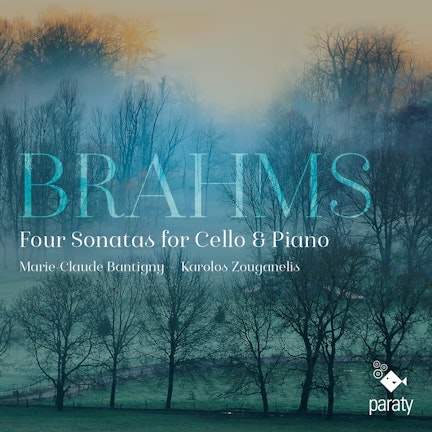
Brahms: Four Sonatas for Cello & Piano
Chopin & Alkan: Sonates pour violoncelle et piano, Op. 65 & Op. 47