This recording uses a larger orchestral formation with a 'wind choir' but occasionally reduces the size to reflect smaller ensembles Brahms knew in Leipzig or Meiningen.
Composer's Artistic Vision
Brahms' four symphonies are considered a central part of the orchestral repertoire, looking back to the tradition of Bach, Haydn, Mozart, and Beethoven, and anticipating future symphonic development.
Interpretation
Most orchestras in Brahms' Germany had around 30 strings, compared to 60 in a modern orchestra, influencing the balance with woodwind sections.
Interpretation
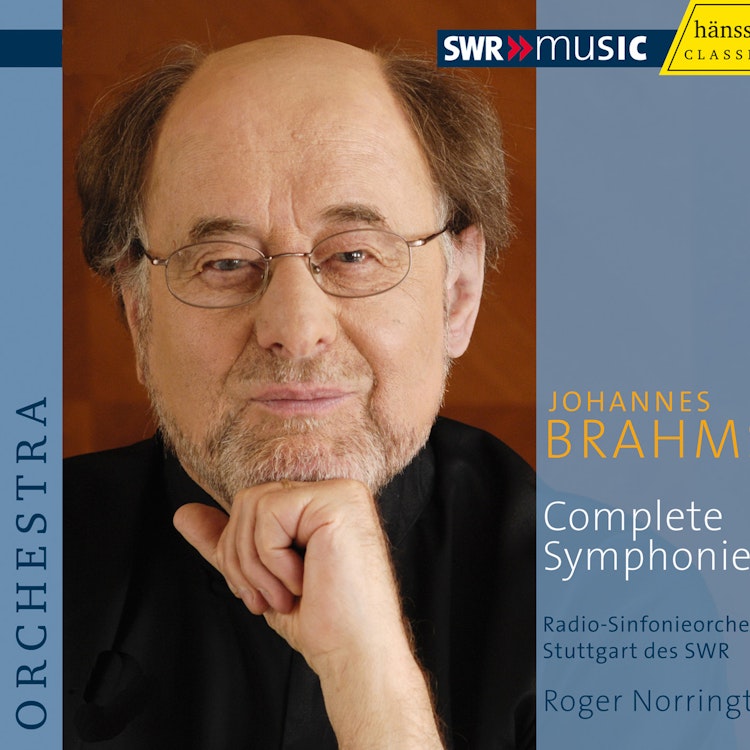
This recording aims to recreate the sound world of Brahms' time by focusing on elements like orchestra size, seating arrangement, tempo, and style, rather than solely using period instruments.
Interpretation
Brahms left few metronome marks in his symphonies, so clues for tempo are derived from Mendelssohn and Schumann (who used metronomes), von Bülow's performance timings, and detailed information from conductor Steinbach.
Historical Context
Orchestras in Brahms' era (1860s-1870s) typically played with a 'pure tone' and adopted continuous vibrato only gradually, with the Vienna Philharmonic maintaining pure tone until 1940.
Performer Biography
Sir Roger Norrington, the conductor, founded the London Classical Players in 1978 to research period-style performance practices for music from 1750 to 1900.
You might also enjoy...
Johannes Brahms: Symphonies No. 1-4
Brahms: Symphonies Nos. 1-4
Antonín Dvořák: Symphonies Nos. 1-4 (Live)
Brahms: Complete Symphonies
Johannes Brahms: Symphonies Nos. 1-4 (Berlin Staatskapelle, Suitner)