Andrés Orozco-Estrada, the conductor on this album, gained international attention in 2004 when he stepped in to conduct the Tonkünstler Orchestra at the Vienna Musikverein and was celebrated as the 'wonder of Vienna'.
Compositional Technique
Brahms' symphonies are described as 'oratorios without words' due to their strong vocal elements, with woodwinds singing arias and chorales appearing in prominent places.
Composition History
Brahms initially struggled with composing a purely instrumental symphony, even admitting to his friend, violinist Joseph Joachim, that 'not even two pianos are enough for me' when orchestrating a sonata.
Composition History
Brahms took nearly a decade to complete his First Symphony, wrestling with new symphonic forms and overcoming concerns about composing symphonies after Beethoven.
Compositional Technique
In the finale of his Fourth Symphony, Brahms used the bass line from J.S. Bach's Cantata BWV 150 as the basis for a passacaglia with 30 variations, adding his own chromatic tones.
Interpretation
The Tonkünstler-Orchester, the ensemble on this recording, uses softer wooden flutes instead of silver or gold flutes in Symphonies 1, 2, and 4 to achieve a transparent orchestral sound.
Composer Biography
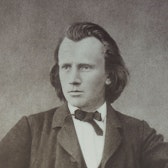
Robert Schumann, a famous composer and critic, prophetically announced the then 20-year-old Johannes Brahms as a 'vocational' musician who would reveal 'wondrous regions' through his music.