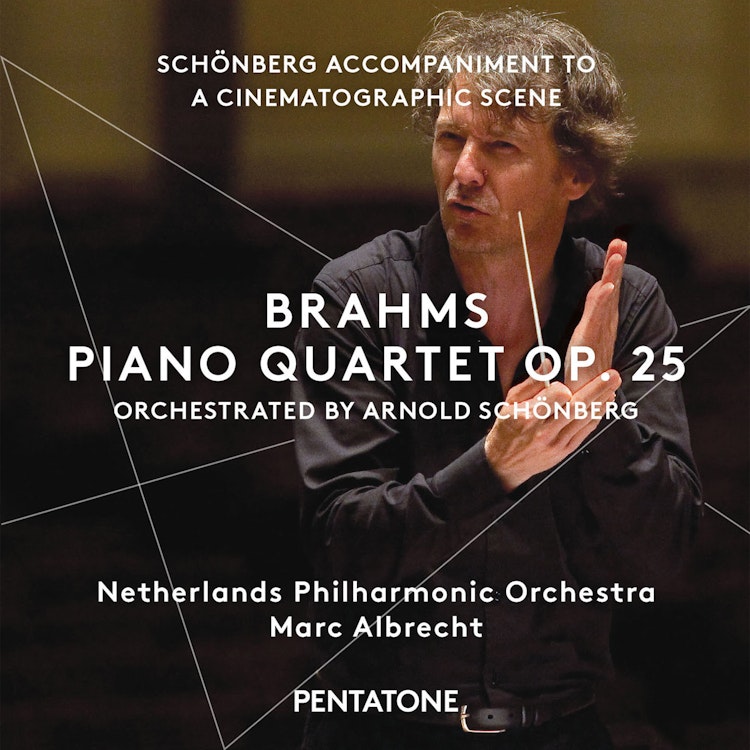
Brahms: Piano Quartet No. 1 in G Minor, Op. 25 (Orch. A. Schoenberg) - Schoenberg: Accompaniment to a Cinematographic Scene, Op. 34
8/7/2015, 5 Tracks, 51:02
Featuring
Marc Albrecht
Nederlands Philharmonisch Orkest
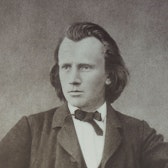
Johannes Brahms
Arnold Schoenberg
Did you know?
1/7
Composition History
Arnold Schönberg orchestrated Johannes Brahms's Piano Quartet in G minor between May and September 1937, stating he liked the piece and wanted to hear all its details, as it was often badly played.
Composition History
Arnold Schönberg's Begleitmusik zu einer Lichtspielszene (Accompaniment to a cinematographic scene) was commissioned in 1929/1930 as a 'film score' by the publisher Heinrichshofen.
Composer's Artistic Vision
Arnold Schönberg's Begleitmusik zu einer Lichtspielszene is a psychogram reflecting three moods: 'Threatening danger,' 'Fear,' and 'Catastrophe,' and was intended for future artistic films.
Compositional Technique
Arnold Schönberg's orchestration of Brahms's Piano Quartet includes trombone glissandi, a xylophone, and a glockenspiel in the finale, which raises questions about whether Brahms would have used such instruments.
Composer Biography
Arnold Schönberg, a composer featured on this album, fled Austria in 1934 to escape National Socialism and settled in Los Angeles, where he taught at the University of Southern California and UCLA.
Performer Biography
Marc Albrecht, the conductor on this album, is the Chief Conductor of both the Dutch National Opera and the Netherlands Philharmonic Orchestra/Netherlands Chamber Orchestra.
Composer's Artistic Vision
Arnold Schönberg considered Johannes Brahms, whose Piano Quartet is orchestrated on this album, a 'Progressive' and saw a direct line from Mozart and Brahms to himself, emphasizing Brahms's innovation.