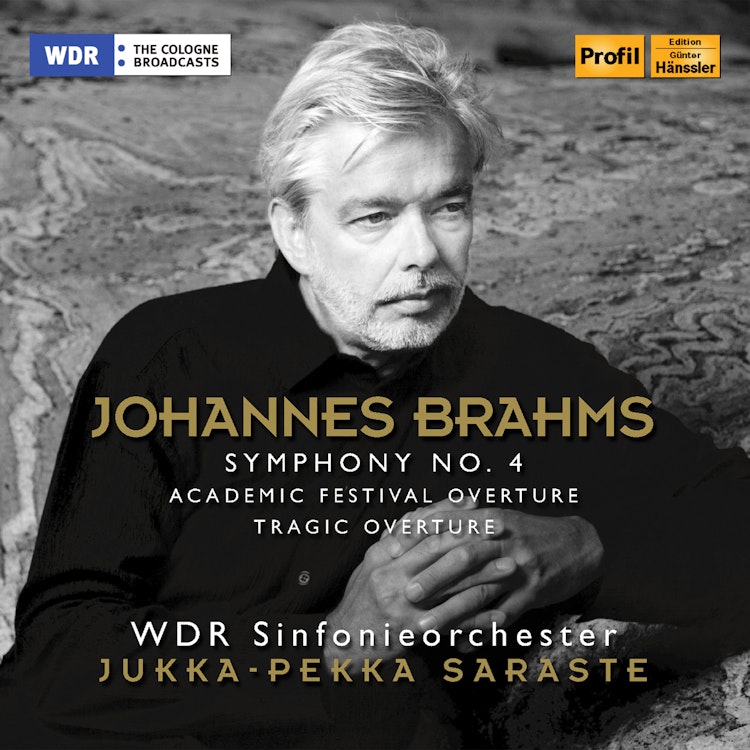
Brahms: Symphony No. 4 in E Minor - Academic Festival Overture - Tragic Overture
4/27/2018, 6 Tracks, 1:01:45
Featuring
Jukka-Pekka Saraste
WDR Sinfonieorchester Köln
Johannes Brahms
Did you know?
1/7
Composer Biography
Johannes Brahms, though praised by Robert Schumann at age twenty, was a self-critical 'late developer' who settled in Vienna in 1862.
Performer Biography
Jukka-Pekka Saraste, the conductor, began his career as a violinist before studying conducting at the Sibelius Academy in Helsinki.
Composer's Artistic Vision
Brahms initially felt unable to break free from the overpowering influence of Beethoven, who had thoroughly exploited the symphony's expressive potential.
Compositional Technique
The Fourth Symphony's final movement is a unique masterpiece based on the Baroque chaconne tradition, featuring thirty variations over a recurring eight-bar chordal theme.
Composition History
Brahms composed his Fourth Symphony in two phases during the summers of 1884 and 1885 in Mürzzuschlag, completing it in September 1885.
Composition History
Brahms himself conducted the premiere of his Fourth Symphony on October 25, 1885, which was prepared by Hans von Bülow, conductor of the Meiningen Hofkapelle.
Critical Reception
A private preview of Brahms's E minor Symphony on two pianos in October 1885 received more criticism than approval from his friends.
You might also enjoy...
Brahms: Symphony No. 2, Tragic Overture & Academic Festival Overture