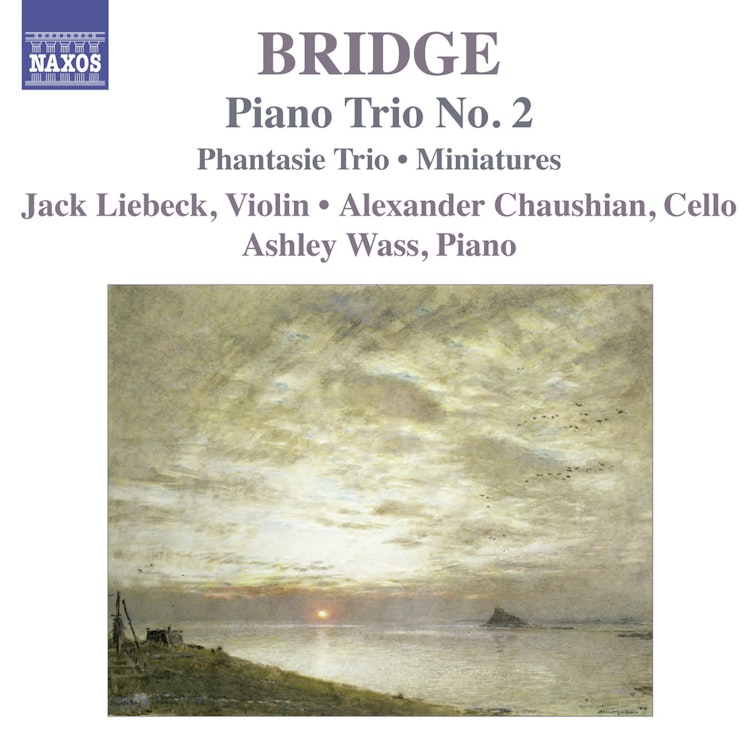
Bridge, F.: Piano Trios Nos. 1 and 2 / Miniatures for Piano Trio
8/24/2009, 17 Tracks, 1:12:35
Featuring
Jack Liebeck
Alexander Chaushian
Ashley Wass
Frank Bridge
Did you know?
1/7
Composition History
The Piano Trio No. 2 was dedicated to Elizabeth Sprague Coolidge, an American patroness of music who financially supported Bridge from the mid-1920s.
Composer Biography
Frank Bridge, the composer, was a pupil of Stanford at the Royal College of Music and later taught Benjamin Britten, his most famous student.
Composer's Artistic Vision
Bridge's music underwent a significant stylistic evolution, moving from late-Romanticism in his early works to an intense, chromatic, and radical language after World War I.
Composition History
An important influence on Bridge's chamber works was the prize instituted by Walter Wilson Cobbett, an amateur musician interested in the Elizabethan and Jacobean 'fantasy' or 'phantasy' form.
Critical Reception
Bridge's late works, including the Piano Trio No. 2, found little favor with the public or critics, and his legacy was largely neglected until the 1970s despite Benjamin Britten's advocacy.
Compositional Technique
Bridge's Piano Trio No. 2 uses melodic lines derived from related major and minor thirds, which combine vertically to create bi-tonal chords (chords made of two keys).
Compositional Technique
Bridge adapted the 'phantasy' form, characterized by thematic unity within a single or multi-movement work, as a hallmark of his compositions.
You might also enjoy...
Cappa Ensemble - Piano Quartets
Howells, H.: To Chosen Hill…Chamber Music
British Piano Quartets
Viola Fantasia
Vaughan Williams: Music for Viola and Piano
Ireland: Sextet; Phantasie Trio; Trios Nos. 2 & 3
Bliss: Oboe Quintet / Piano Quartet / Viola Sonata
Walton, Bridge & Lekeu: Piano Quartets
Coleridge-Taylor, S.: Clarinet Quintet in F Sharp Minor / 4 African Dances / Nonet in F Minor
Cooke: Chamber Piano Works
Skylla und Charybdis - Graham Waterhouse
Rob Keeley: Songs, Chimes & Dances
Dale: The Romantic Viola
Bax: Nonet, Oboe & Harp Quintets, Clarinet Sonata & Elegie