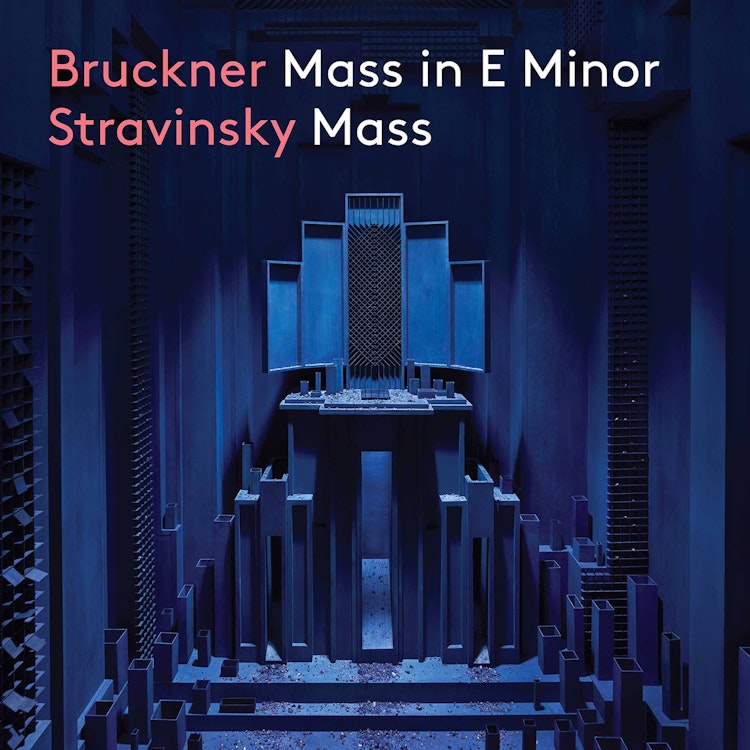
Bruckner: Mass No. 2 in E Minor - Stravinsky: Mass
6/5/2020, 17 Tracks, 53:10
Two unconventional masses are juxtaposed in this album from conductor Gijs Leenaars and his Rundfunkchor Berlin: those of Anton Bruckner and Igor Stravinsky. Both of these striking works, which blend the old with the new in unexpected ways, are for choir and wind ensemble – here, players from the Rundfunk-Sinfonieorchester Berlin. Bruckner’s Mass No. 2 in E minor is performed in its 1882 version; Stravinsky wrote his Mass in the 1940s.
Featuring
Yoo-hoon Shin
Gijs Leenaars
Barbara Berg
Christine Lichtenberg
Mathis Koch
Wolfram Teßmer
Rundfunkchor Berlin
Anton Bruckner
Igor Stravinsky
Did you know?
1/7
Composer's Artistic Vision
Bruckner, a deeply religious 'musician of the Lord,' intended his Mass in E minor for liturgical use, not concert performance, as indicated by introductory passages not set to music.
Composer's Artistic Vision
Stravinsky intended his Mass for church use, not concert halls, despite the premiere ultimately being held at La Scala in Milan.
Composition History
Stravinsky's Mass was unusual for him as it was neither commissioned nor composed for a specific occasion, but inspired by his chance discovery of Mozart masses.
Composition History
Bruckner's Mass in E minor was commissioned by Bishop Franz Joseph Rudigier to commemorate the dedication of a votive chapel, part of a new cathedral.
Composition History
The unusual orchestration of Bruckner's Mass in E minor, for mixed choir and wind ensemble without vocal soloists, was due to the special worship service being held outdoors.
Composer's Artistic Vision
Stravinsky described his Mass as 'very cold music, absolutely cold, that will appeal directly to the spirit,' aiming for an unromantic tone.
Compositional Technique
Bruckner's Mass in E minor features intricate polyphony of up to eight voices and demanding a cappella passages requiring precise intonation and stamina.
You might also enjoy...
Gounod: Messe solennelle de Sainte Cécile
Beethoven: Mass in D Major, Op. 123 "Missa solemnis"
Dvorák: Mass in D Major, Op. 86
Gounod: St. Cecilia Mass / Bizet: Te Deum
Beethoven: Missa solemnis, Op. 123 (Live)
Rossini: Stabat Mater
Anton Bruckner: Mass No. 2 (1882 version) / Te Deum [1884 version] [Berlin Radio Chorus and Symphony Orchestra, Rogner]
Rossini: Stabat Mater
Bruckner: Mass No. 1 in D Minor
Beethoven: Missa solemnis, Op. 123
Beethoven: Mass in D Major, Op. 123 "Missa Solemnis"
Suppe: Requiem
Bruckner: Messe F-moll
Cherubini: Mass No. 2 in D Minor, "Messe Solennelle"