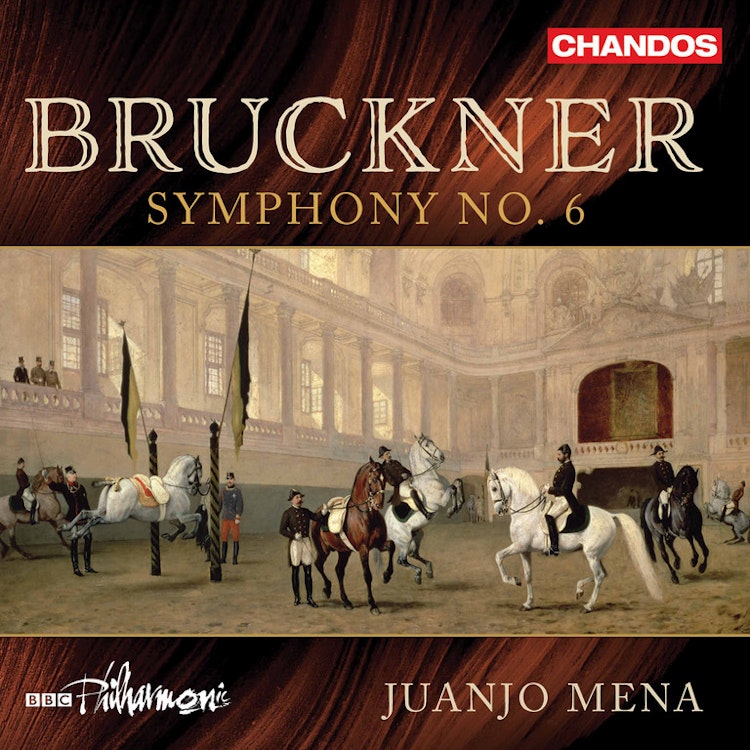
This Chandos recording uses 24-bit / 48 kHz technology, which offers a dynamic range up to 48 dB greater and 256 times the resolution of standard 16-bit recordings.
Composer Biography
Bruckner, a brilliant organist, found spiritual sanctuary and practiced in great cathedrals and churches like St Stephen's Cathedral in Vienna.
Critical Reception
After the premiere of his Third Symphony, critics were uncomprehending, with Eduard Hanslick, Bruckner's arch-enemy, dismissing it as a vision of Beethoven's Ninth befriending Wagner's Walküre.
Composition History
The disastrous premiere of Bruckner's Third Symphony in Vienna in 1877, which he had to conduct himself after the sudden death of his champion Johann Herbeck, was a key event influencing his subsequent works.
Compositional Technique
One striking feature of the Sixth Symphony is its contrast between darkness and light, with the A major home key suggesting brightness while themes below it are dark and heavy.
Critical Reception
Bruckner's Symphony No. 6 was considered the 'Cinderella' of his symphonic cycle for most of the 20th century, performed and recorded less often than his other symphonies.
Compositional Technique
The Sixth Symphony is shorter than Bruckner's other mature symphonies and features a slow movement in a relatively straightforward sonata form, departing from his usual expanded rondo procedure.
You might also enjoy...
Bruckner: Symphony No. 4
Bruckner, A.: Symphony No. 5
Bruckner: Symphony No. 4, 'Romantic'
Bruckner: Symphony No. 1 in C Minor, WAB 101 (Vienna Version)
Bruckner, A.: Symphony No. 8
Bruckner: Symphony No. 4 in E-Flat Major, WAB 104 "Romantic"
Bruckner: Symphony No.4 in E-flat Major, WAB 104 (Edition Haas)
Anton Bruckner: Symphony No. 9 in D minor. With Finale (Version by Samale et al.)
Bruckner: Symphony No. 4 in E Flat Major
Bruckner: Symphony in F Minor, WAB 99 ("Nullified" First Symphony, also called "Study Symphony")