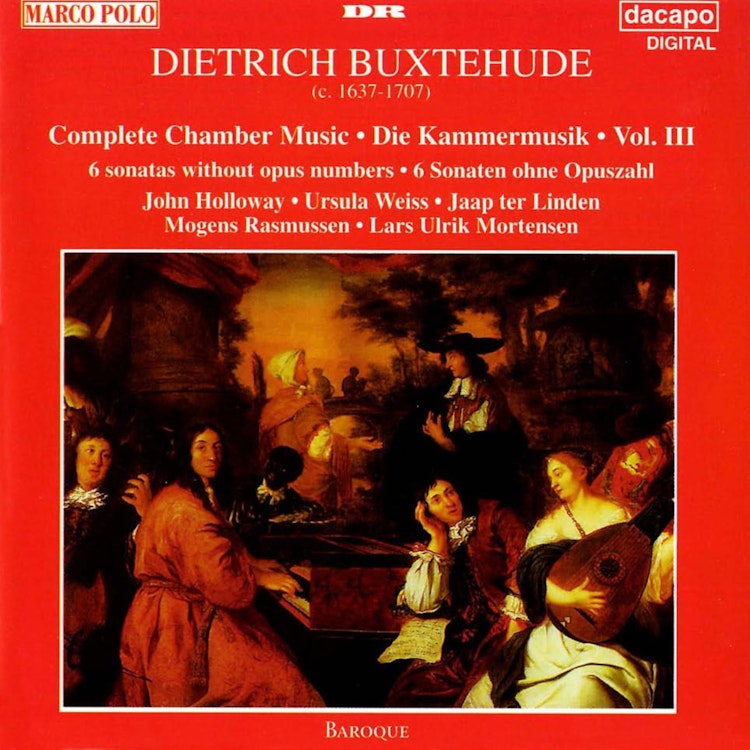
Buxtehude: Chamber Music (Complete), Vol. 3 - 6 Sonatas
12/15/1995, 21 Tracks, 52:29
Featuring
John Holloway
Ursula Weiss
Jaap ter Linden
Lars Ulrik Mortensen
Mogens Rasmussen
Dietrich Buxtehude
Did you know?
1/7
Composer's Artistic Vision
Buxtehude's sonatas combine free and bound compositional principles, reflecting a musical and philosophical idea of a 'musical microcosm' mirroring the universe.
Composition History
A significant portion of Buxtehude's music, including cantatas and large-scale organ works, was not written as part of his official duties as an organist.
Historical Context
Lübeck, where Buxtehude worked, had a vibrant musical culture, including municipal musicians known as the Ratsmusik, who performed in both church and secular settings.
Composer Biography
Dietrich Buxtehude, whose birth date and place are unknown, was appointed organist at St. Mary's Church in Lübeck, Germany, in 1668, a highly prestigious position.
Instruments
In his sonatas, Buxtehude preferred the soft-sounding viola da gamba over the violone or cello for the bass melody, aligning with German instrumental tradition.
Composition History
Buxtehude published two collections of instrumental chamber music, Opus 1 and Opus 2, which were among the few works printed during his lifetime.
Composer's Artistic Vision
Buxtehude's sonatas are characterized by the 'fantastic style,' which allowed for free composition without strict limitations, akin to improvisation.
You might also enjoy...
From Venice to Versailles
Leclair: Trio Sonatas
Schmelzer: Baroque World Theatre
J.S. Bach: Musikalisches Opfer
Buxtehude & Pachelbel Chamber Music
The Trio Sonata Through Two Centuries
Handel 'Oxford' Water Music
Telemann: Suite Burlesque De Quixotte / Concerto for Strings in D Major
Chaconne
Telemann Edition, Vol. 3
Leclair: Premiere Recreation De Musique D'Une Execution Facile / Sonata for 2 Violins in D Major
Gottfried Heinrich Stölzel: Kammermusik
An Excess of Pleasure
Telemann: Overtures - Du angenehmer Weiberorden - Trauer-Music eines kunsterfahrenen