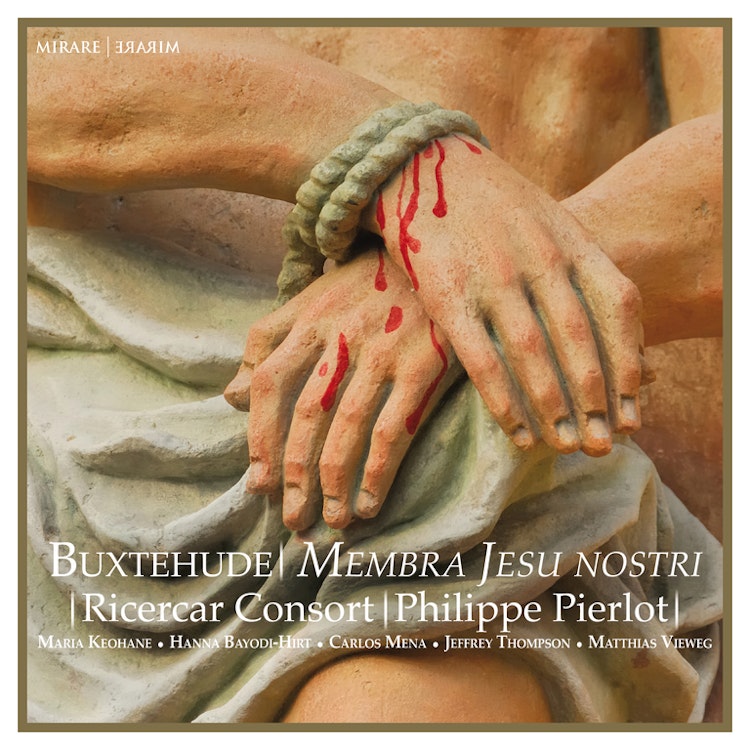
In "Membra Jesu nostri," Buxtehude uses musical elements like triple time, threefold repetition, or three voices to symbolize the concept of divinity.
Composer's Artistic Vision
Buxtehude likely compiled the text for "Membra Jesu nostri" himself, possibly with theologians, to align with Martin Luther's meditation precepts on the Passion.
Composition History
Gustav Düben, to whom Buxtehude dedicated "Membra Jesu nostri," had copies of Buxtehude's works transcribed, and these copies are now the most important source for Buxtehude's sacred music.
Compositional Technique
The cycle of cantatas in "Membra Jesu nostri" is structured around the sacred number seven, which is also fundamental to the medieval hymn "Rhythmica oratio."
Composition History
Buxtehude dedicated his work "Membra Jesu nostri" to his friend Gustav Düben, the director of music to the King of Sweden, in 1680.
Recording & Production
This recording was made in September 2018 at the Abbaye de la Lucerne d'Outremer in France, a Premonstratensian abbey founded in 1143.
Composition History
This album's main work, "Membra Jesu nostri," is the only vocal work by Buxtehude for which his own dating exists.
You might also enjoy...
Bach: Cantatas and Arias for Bass
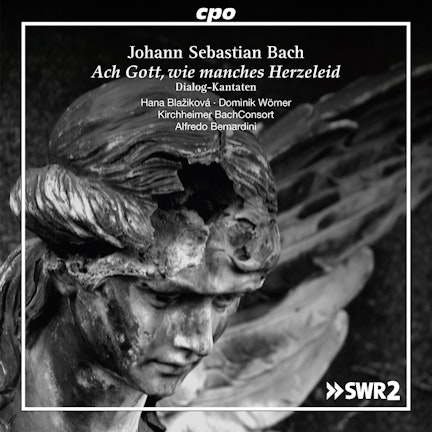
J.S. Bach: Dialog-Kantaten
J.S. Bach: Cantatas, Vol. 31 (Live)
Telemann: Advents Cantatas
Bach, J.S.: Sinfonia
Dieterich Buxtehude: Membra Jesu nostri, BuxWV 75
J.S. Bach: Was mein Gott will, das g'scheh allzeit, BWV 111
Bachkantate, BWV 105 - Herr, gehe nicht ins Gericht mit deinem Knecht
J.S. Bach: Nun komm, der Heiden Heiland, BWV 62
Membra Jesu Nostri: I. Ad pedes
J.S. Bach: Der Himmel lacht! Die Erde jubilieret, BWV 31
J. S. Bach: Man singet mit Freuden vom Sieg, BWV 149
J.S. Bach: Gott, der Herr, ist Sonn und Schild, BWV 79