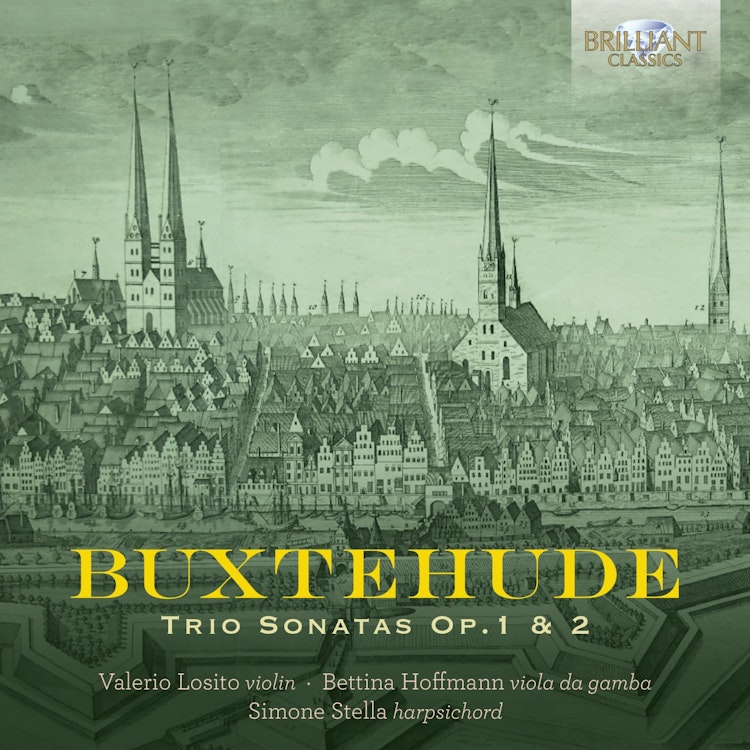
Buxtehude chose the viola da gamba, with its gentler sound and three-octave range, over the violone or cello for the low-range melodic instrument in these sonatas, following German tradition.
Composer Biography
Dieterich Buxtehude, the composer, was considered Danish by his contemporaries, despite his family originating from Lower Saxony.
Performer Biography
Simone Stella, the harpsichordist, won First Prize in the 1st International Organ Competition 'Agati-Tronci' in Pistoia in 2008, awarded by Gustav Leonhardt.
Cultural Impact
Johann Sebastian Bach, at age 20, walked 200 miles to Lübeck in 1705 to hear Buxtehude perform, extending his four-week leave to four months due to the experience.
Performer Biography
Bettina Hoffmann, the viola da gamba player on this album, is also a musicologist who discovered and edited the only known German treatise on the viol.
Composition History
Buxtehude's Trio Sonatas Opp. 1 and 2 are among the few works he published during his lifetime, released around 1690-1696.
Compositional Technique
Buxtehude's sonatas employ the 'Stylus Phantasticus,' a style that combines written improvisation with strict counterpoint, reflecting a philosophy where compositional freedom meets technical discipline.
You might also enjoy...
Telemann: Voyageur virtuose
Johann Philipp Kirnberger
Telemann: Recorder Music
The Telemann Album (Aulos Ensemble)
Gluck: Trio Sonatas
Handel: Trio Sonatas Op. 2
Buxtehude: Complete Chamber Music
Abel & Bach: Chamber Music
Durante: Studii e divertimenti per cembalo con due Toccate e le Variazioni sulla Follia di Alessandro Scarlatti
De Bach A Mozart Sur Les Trac
Bach: Suite in C Minor, BWV 997 & Trio Sonatas Nos. 1, 2 & 5