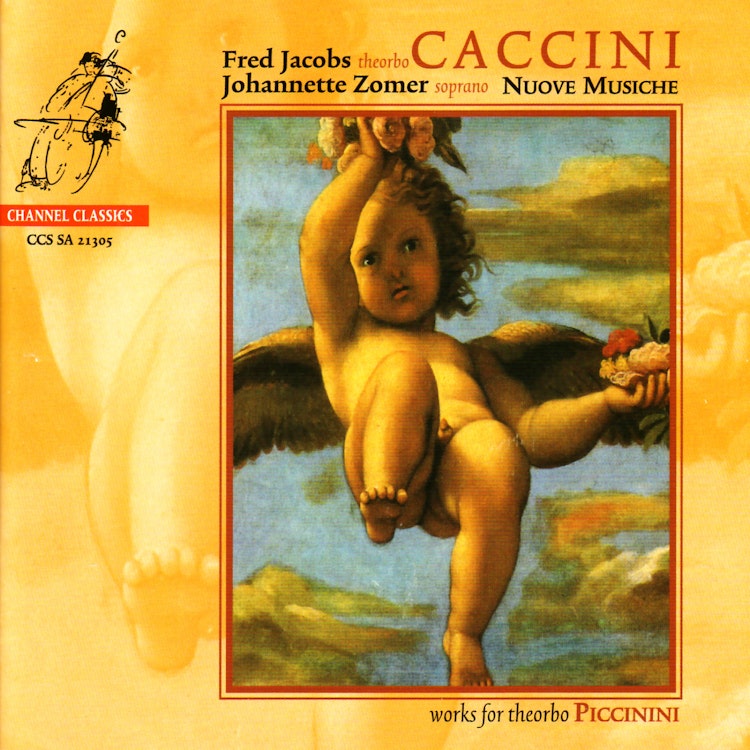
Caccini: Nuove Musiche & Piccinini: Works for Theorbo
1/1/2005, 21 Tracks, 54:52
Featuring
Johannette Zomer
Fred Jacobs
Giulio Caccini
Alessandro Piccinini
Did you know?
1/7
Historical Context
Giulio Caccini's 'Nuove Musiche' emerged from discussions in Florence during the 1570s by a group called Bardi's Camerata, which sought to revive ancient musical theories.
Composer's Artistic Vision
Caccini's 'Nuove Musiche' introduced a new style of singing, which he described as 'speaking in musical tones' and using 'sprezzatura' to approach the essence of poetic text.
Performer Biography
Fred Jacobs, the theorbo player, is a founder of The Locke Consort and a member of several other notable early music ensembles.
Compositional Technique
Caccini intentionally ignored counterpoint rules, using the bass line to support the voice and improvising harmonically to strengthen the text's expression.
Performer Biography
Johannette Zomer, the soprano on this album, trained as a microbiologist before studying at the Sweelinck Conservatorium in Amsterdam.
Instruments
Alessandro Piccinini, a court lutenist and theorbo virtuoso, was also a pioneer in the construction of the theorbo, a large plucked instrument.
Recording & Production
This recording was made in November 2004 at the Doopsgezinde Kerk in Deventer, The Netherlands, using Bruel & Kjaer and Schoeps microphones.
You might also enjoy...
Le Jeune: Airs et psaumes
Italian Lute Songs
Robin Is To The Greenwood Gone - Elizabethan Lute Music
Lute Works
Lindberg: Seven Suites of Swedish Folk Tunes
Corbetta: Guitar Music
Della Ciaia: Lamentationi
Granados: Danzas españolas
Abel, C.F.: Viola Da Gamba Suites
Medieval and Renaissance Music (Graysteil - Music From the Middle Ages and Renaissance in Scotland)
Raw Emotions: North American Tuba Concertos
Christian Wolff: Look She Said (Complete Works for Bass)