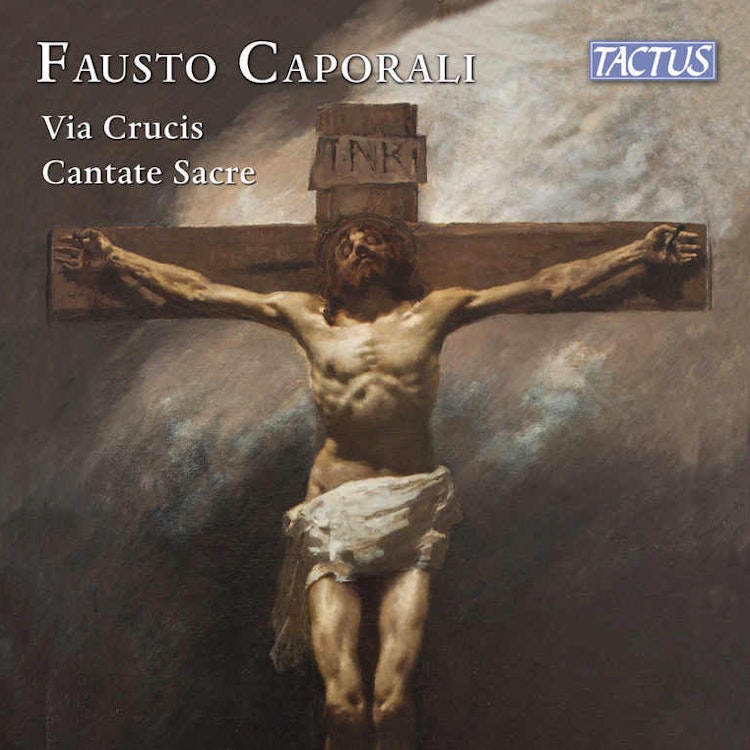
The album cover features Gaetano Previati's (1852-1920) painting, Cristo crocifisso (Christ crucified).
Instruments
The recording of the Via Crucis features the 1781 Julián de la Orden organs of Malaga Cathedral, while the Cantatas use the 1986 Mascioni organ of Cremona Cathedral.
Compositional Technique
The Via Crucis incorporates diverse musical styles, including traditional forms like Fugue and Toccata, ancient and modern styles such as Scherzo and Jazz, and even cluster effects to represent heartbeats or crashes.
Composer's Artistic Vision
Fausto Caporali's Via Crucis uses many musical languages without preclusions, reflecting the idea that all human voices are expressive and the path to the Cross is open to everyone.
Compositional Technique
The Cantata for the Patron Saints of Malaga uses musical contrasts between themes and timbres, such as ascending/descending melodies, children's voices versus organ, and rhythmic irregularity, to describe the texts.
Compositional Technique
The Cantata for St. Mary of Victory extensively uses local musical elements, including a lullaby from Manuel de Falla, popular quotations, liturgical echoes, and Bolero rhythms, to depict the siege and conquest of Malaga.
Compositional Technique
A portion of Fausto Caporali's Via Crucis is not written down and is left to improvisation, allowing each performance to be updated and personalized.
You might also enjoy...
Rheinberger.: Musica sacra, Vol. 1
Simon Mold: Passiontide
Rheinberger: Der Stern von Bethlehem, Op. 164
Herrnhuter Weihnachten (Moravian Christmas)
Wagner: Das Liebesmahl der Apostel, WWV 69
Reger: Sämtliche Choralkantaten
Dvorák: Stabat mater, Op.58
Pucklitz: Opera Omnia, Vol. 2
Dvořák: Stabat Mater
Dvořák: Stabat Mater, Op. 58, B. 71
Kallembach: Most Sacred Body
Dvorak: Stabat Mater conducted by Rafael Kubelik live