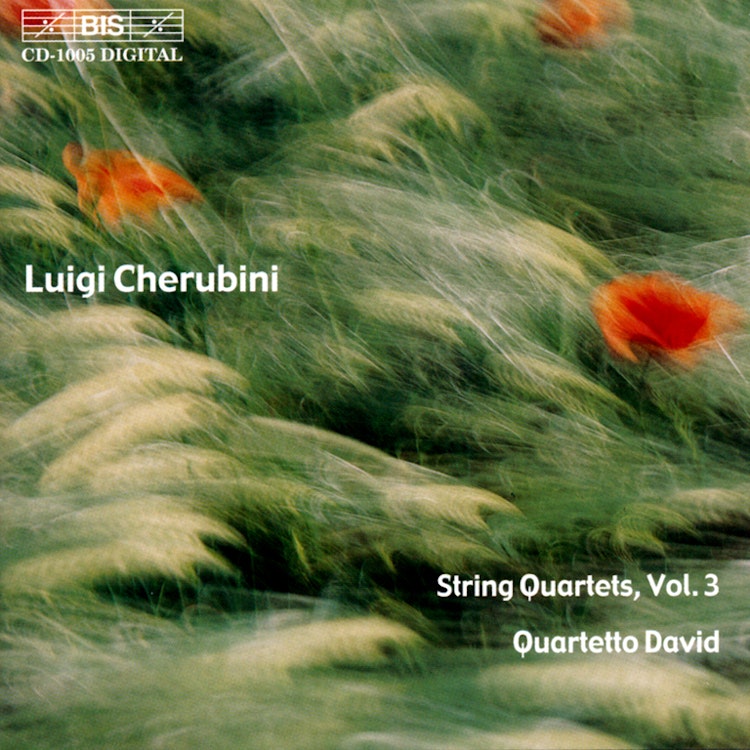
Cherubini: String Quartets Nos. 5 in F Major and 6 in A Minor
2/1/2001, 8 Tracks, 54:57
Featuring
Mauro Loguercio
Gabriele Baffero
Antonio Leofreddi
Marco Decimo
David Quartett
Luigi Cherubini
Did you know?
1/7
Composer Biography
Cherubini composed works celebrating both the Revolution, like Hymne à la fraternité, and the monarchy, such as the Requiem in C minor commissioned by Louis XVIII.
Composer's Artistic Vision
In his string quartets, products of his final maturity, Cherubini achieved an original style that showed his awareness of the great German quartet tradition, despite drawing on the contemporary style that favored the first violin's virtuosity.
Critical Reception
Despite being forgotten in Italy, Ludwig van Beethoven regarded Cherubini as the greatest dramatic composer in 1805, and by 1817, as the greatest living composer.
Composer Biography
Luigi Cherubini, born in Florence in 1760 and died in Paris in 1842, witnessed a musical evolution from Gluck's Orfeo ed Euridice to Wagner's Tannhäuser.
Composer Biography
Cherubini's haughty and unsociable character provoked open antipathy from Napoleon, who was resentful of not receiving more obvious displays of deference.
Critical Reception
In Italy, Cherubini was largely forgotten after Rossini's arrival, with his opera Medea only being revived 121 years after its 1788 performance, without much interest.
Critical Reception
Cherubini's opera Medea became his most famous work, admired by musicians like Ludwig van Beethoven and Johannes Brahms, and later by Maria Callas, whose interpretation Sviatoslav Richter called the most exciting operatic experience he had ever heard.
You might also enjoy...
Haydn: The Seven last Words of Christ
Haydn: String Quartets Op. 33, Nos. 4-6
Haydn: String Quartets, Op. 55 "Tost II" (On Period Instruments)