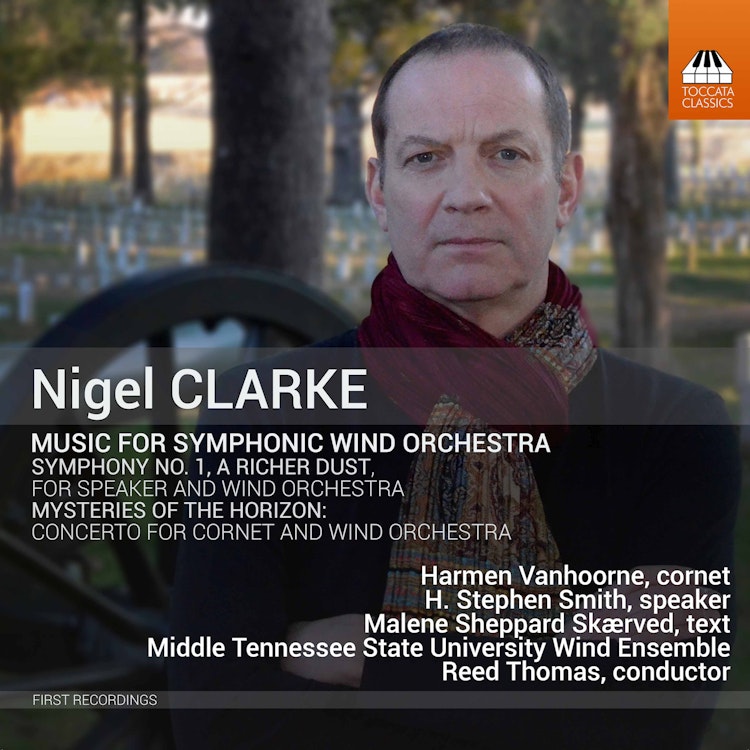
For "A Richer Dust," composer Nigel Clarke purchased a 1916 trench whistle of a WWI British officer, which is blown by the speaker during the brutal climax of the music.
Compositional Technique
Unusually, "Mysteries of the Horizon" has four movements, each titled after a René Magritte painting, rather than the standard three movements of most classical concertos.
Composer's Artistic Vision
Nigel Clarke's "Mysteries of the Horizon" is inspired by four surrealist paintings by René Magritte, a Belgian artist, aiming to reflect the atmosphere of each painting.
Composition History
Nigel Clarke's "Mysteries of the Horizon" was originally written in 2012 for cornet virtuoso Harmen Vanhoorne and Brass Band Buizingen, then re-written for wind orchestra in 2015.
Composition History
Nigel Clarke's Symphony No. 1, "A Richer Dust," was commissioned by Dr. Reed Thomas and the Middle Tennessee State University (MTSU) Wind Ensemble, exploring themes of violence and extremism.
Performer Biography
Harmen Vanhoorne, the cornet soloist, is an international virtuoso known for commissioning new works and expanding the cornet repertoire, and was named International Soloist of the Year in 2011.
Composer's Artistic Vision
The title "A Richer Dust" was inspired by a photograph of a pulverised WWI battlefield and a line from Rupert Brooke's poem 'The Soldier': 'In that rich earth a richer dust concealed'.